Canada Builds the Waterbombers. The Fires Won’t Wait.
Federal contracts sent ten additional aircraft into nine provinces and territories in 2026. But we still don't know where crews had to wait — or whether a reserve could have helped.
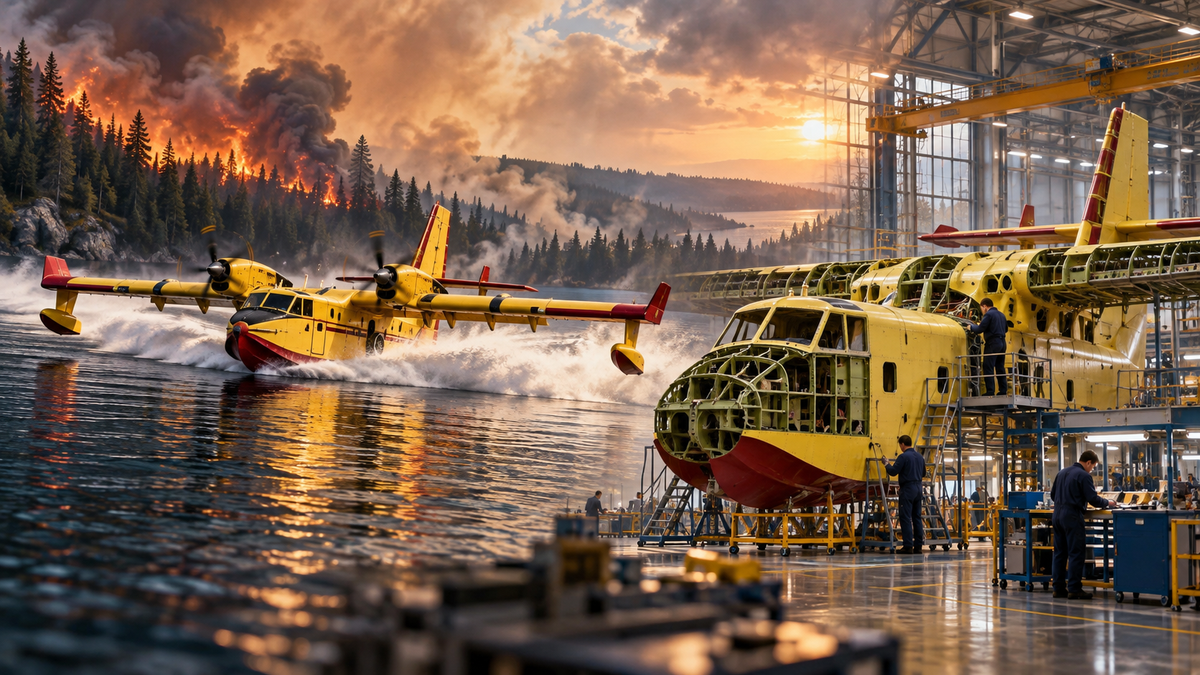
A Canadian aircraft is back in demand around the world. That's an opportunity for our aerospace industry, but the harder test is whether Canadians have enough firefighting capacity while the new planes are being built.
The Canadair 515 can scoop more than 6,000 litres of water in about 12 seconds. Building one takes years, and De Havilland Canada has customers waiting.
In an October 18 interview with The Canadian Press, company vice-president Neil Sweeney said 38 aircraft are on order, with production committed through 2034. He proposed that Canadian governments coordinate a 50-aircraft purchase to help justify a second production line costing hundreds of millions of dollars. It's a manufacturer's argument for expanding capacity, not an independently costed government plan.
The Canadian Press also reviewed a draft Canada–European Union statement contemplating the purchase of 50 waterbombers later this month. Whether those planes include existing orders or would add to them is unclear. A draft statement is not a signed contract, and the two references to 50 aircraft should not be added together.
Canada has a surge fleet. Is it enough?
Ottawa's October wildfire update recorded more than 5,400 fires and roughly 4.5 million hectares burned in 2026. More than 33,750 people were displaced, including over 8,800 from First Nations communities. The area burned was lower than in 2025, but Canada's latest climate assessment points to longer fire seasons and more extreme fire weather as temperatures rise.
Firefighting aircraft are largely a provincial and territorial responsibility, with governments drawing on their own fleets, private operators and arrangements to share equipment. Ontario has 28 specialized aircraft and six Canadair 515s on order. But owning an aircraft, contracting one and having it ready to dispatch when needed are different things.
Ottawa's Pan-Canadian Aerial Asset Program committed $316.7 million over five years to additional national capacity coordinated through the Canadian Interagency Forest Fire Centre. For 2026, it contracted four land-based airtankers, one air-attack aircraft and five heavy helicopters, plus two temporary forward tanker-base assets. They were seasonal contracted resources, not ten federally owned Canadair scoopers.
The aircraft put in more than 2,120 flight hours and made 14,400 water or retardant drops, operating across nine provinces and territories. That's substantial work. The missing figures are just as important: how many requests went unfilled, how long crews waited, and whether aircraft positioned elsewhere could have reached threatened communities sooner.
A June Senate report called for a nationally funded fleet, properly staffed and positioned, alongside better coordination and Indigenous participation. The federal contracts are a start. They don't yet settle how much dependable surge capacity Canada needs when several regions are burning at once.
The factory is a different bottleneck
The Canadair's advantage is its ability to refill from suitable lakes and other water bodies rather than returning to an airport after every drop. It can't do every job: land-based tankers and helicopters have different strengths, and geography, weather and fire behaviour determine what works.
Demand for the new model is real. De Havilland reported 22 European orders in March, and France added two more in June. Canadian commitments account for another 14: six from Ontario, five from Alberta and three from Manitoba. Those disclosed orders account for the reported total of 38.
The first new aircraft is projected for delivery to a European customer in 2028. Alberta expects its first in spring 2031; Manitoba expects one in 2031 and two in 2032.
Restarting production meant rebuilding a supplier network for an aircraft family with roughly 60,000 parts, according to The Canadian Press. De Havilland's July update showed progress on the first fuselage and wing structures, and the company broke ground in May on De Havilland Field in Alberta, a planned centre for assembly, parts and aircraft support.
A second production line may be worthwhile, but public commitments should depend on credible supplier-capacity forecasts, certification and delivery milestones, staged spending and remedies for missed schedules. Buying more places in a queue isn't the same as shortening it.
Make the Canadian content count
De Havilland says its broader business has an 80 per cent Canadian-based supply chain. That is not a verified Canadian-content figure for the Canadair 515, and governments should not treat it as one.
A coordinated order could help Canadian firms expand into structures, machined parts, wiring, electronics, hydraulic systems and long-term maintenance. Not every component needs to be domestic, but procurement should measure where engineering is done, which parts can be repaired or replaced here, how quickly aircraft return to service and whether suppliers can sustain the work beyond a single order. Canadian content has to be measured, not painted on a fuselage.
Could the RCAF provide a reserve?
The military already helps during wildfire emergencies. Under Operation LENTUS, RCAF Hercules transports made 14 flights in July to evacuate more than 900 Eabametoong First Nation residents. Those were evacuation flights, not waterbombing missions.
Ottawa has also conditionally sold ten retired CC-130H Hercules to B.C.-based Coulson Aviation for civilian firefighting conversion. Contractual and regulatory steps remain; ten planes earmarked for conversion are not ten operational airtankers.
There is a model worth examining south of the border. The United States uses removable Modular Airborne Fire Fighting Systems (MAFFS) in military C-130 transports. Each system can release about 3,000 U.S. gallons of retardant, with military crews working alongside civilian fire agencies when commercial resources are stretched. Unlike a scooper, a MAFFS aircraft needs airport-based refilling.
Canada could evaluate a limited trial on a suitable RCAF transport, but an American example is not proof of compatibility or Canadian airworthiness approval. The test would need certified equipment, trained crews, tanker-base support and an agreement on which military duties could be deferred. Parliamentary defence witnesses have disagreed on whether a larger disaster-response role would strengthen national resilience or divert military resources from their primary work.
A small military reserve might help during exceptional fire seasons. Expanding civilian leases might help more. The comparison should be based on availability, cost and the effect on other essential services, not on the appeal of putting existing aircraft to a new use.
Make the next decisions measurable
For 2027, governments need a common inventory of aircraft, contracts, crews, maintenance capacity, usable bases and gaps exposed during simultaneous fires. Publishing unfilled requests and response times would help determine whether longer leases, forward deployment, additional technicians or another aircraft mix could produce faster results.
Longer term, Ottawa and the provinces can coordinate Canadair purchases and tie any manufacturing incentives to demonstrable production and Canadian supplier gains. A limited RCAF trial deserves comparison with civilian options, not automatic approval.
Aircraft are only one part of a wildfire response. As the BC Wildfire Service explains, they support ground crews; they cannot contain a wildfire alone. Detection, prevention, fuel management, evacuation planning and Indigenous-led fire stewardship belong in the same strategy.
Canada should keep two scoreboards: aircraft and crews genuinely available for the next fire season, and new aircraft actually delivered on schedule in the years ahead. Announcements count for little until those numbers improve.
Build the planes for the future. Keep help flying next summer.