Canada Has the Uranium. The Next Test Is What It Builds With It.
Ontario is building the country’s first BWRX-300, Saskatchewan is planning for nuclear generation, and Ottawa wants uranium exports doubled by 2035. The next phase of Canada’s nuclear story is moving from resource strength to industrial execution.
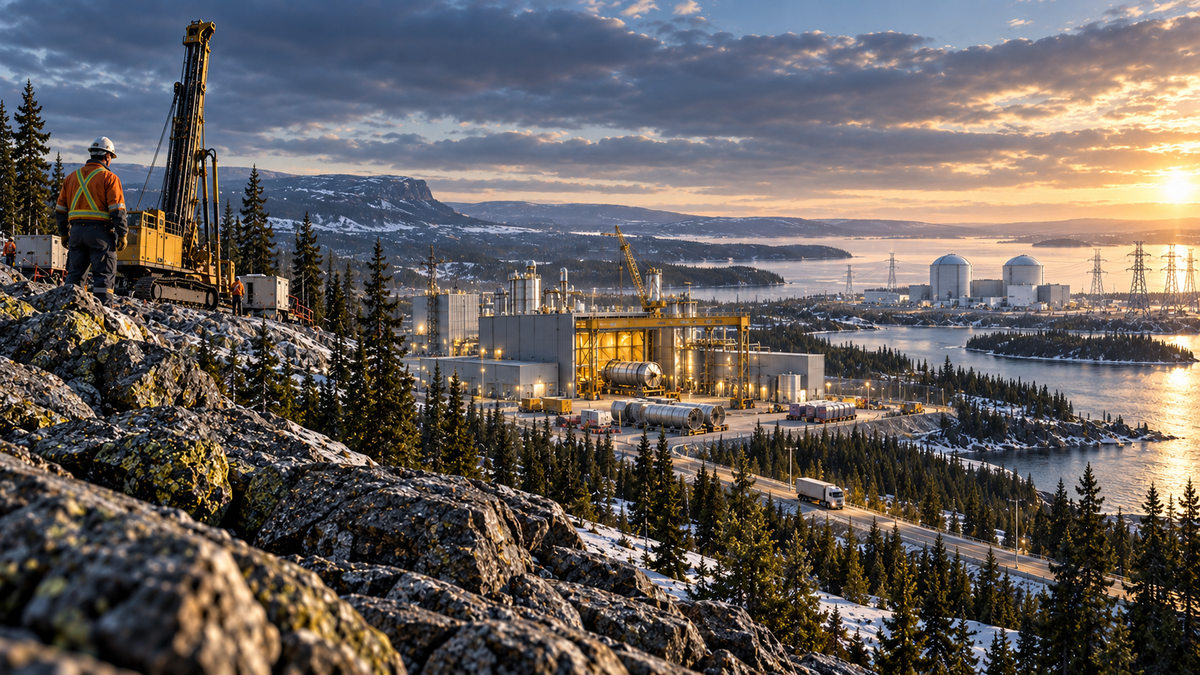
Canada already supplies the uranium. The next nuclear build-out will test whether that resource strength can become reusable Canadian capability — in fuel, reactors, suppliers, skills and ownership.
A small drilling program started this morning in northern Saskatchewan. Xcite Uranium says it has begun a six-hole, 1,300-metre program at its Black Bay project, about 20 kilometres south of Uranium City, with roughly $1.1 million budgeted for the project this year.
On its own, that is exploration. The national context is already established. Canada produced roughly 24 per cent of the world’s uranium in 2024 and exported about 90 per cent of it, while the U.S. Energy Information Administration says Canada supplied 32 per cent of the uranium delivered to American civilian reactor operators in 2025, making it their largest source. In March, Saskatoon-based Cameco added another major customer with a nine-year agreement to supply India with nearly 22 million pounds of uranium concentrate, worth an estimated $2.6 billion.
Ottawa now wants uranium exports doubled between 2024 and 2035 while strengthening fuel supply chains for Canadian reactors by 2032. That puts the opportunity in useful terms: keep selling a resource Canada is exceptionally good at producing, while using the next reactor build-out to deepen capabilities that can be used again.
Saskatchewan wants to move downstream
For decades, Saskatchewan’s place in the nuclear economy has been overwhelmingly at the front end. Uranium leaves the province and eventually generates electricity somewhere else. Now Saskatchewan is considering adding nuclear generation to the other end of that equation.
On September 29, the province established a goal of at least 2,600 megawatts of nuclear generation by 2050. SaskPower has been directed to plan for the potential development of two large reactors in northwest Saskatchewan totalling more than 2,000 MW, with the first targeted for around 2042, while planning continues near Estevan for at least 600 MW of small modular reactor capacity.
Plans are not commitments. SaskPower says it will not make a final investment decision on an SMR facility until 2029. But one important choice has already been made: in 2022, the utility selected the GE Hitachi BWRX-300, the same design Ontario Power Generation selected for Darlington.
SaskPower specifically cited the advantages of a pan-Canadian fleet approach. If Saskatchewan proceeds, it does not have to begin with a blank sheet of paper. Ontario is already doing the expensive first work.
Ontario is building the reference project
The Canadian Nuclear Safety Commission currently lists one BWRX-300 unit at Darlington as under construction. The Commission issued OPG its construction licence in April 2025, removed the first major regulatory hold point in March 2026 and is considering OPG’s separate application for an operating licence.
OPG ultimately plans four BWRX-300 units at Darlington, subject to further approvals. Together they would provide 1,200 MW, with the current budget for the four-unit project estimated at $20.9 billion.
There is at least some recent Canadian evidence that complex nuclear work does not have to default to delay and overrun. Natural Resources Canada says Darlington’s Unit 4 refurbishment finished four months early and $150 million under budget. That is encouraging project-execution evidence, but it is not proof that constructing the first commercial BWRX-300 will follow the same path. Refurbishing an existing reactor and building a first-of-kind design are different jobs.
The value of Ontario and Saskatchewan choosing the same reactor is therefore less about the technology badge than what can be repeated around it. Licensing experience, construction methods, component suppliers, training and operating knowledge all become more valuable if the next project can use what the first one learned.
Much of the fuel chain is already here
Canada is not starting from zero once uranium comes out of the ground.
Cameco operates the world’s largest commercial uranium refinery at Blind River, Ontario, conversion capacity at Port Hope, and CANDU fuel-manufacturing operations in Ontario. Port Hope produces uranium dioxide for heavy-water reactor fuel as well as uranium hexafluoride, or UF6, which becomes feedstock for enriched light-water reactor fuel.
Canada also retains reactor technology of its own. Atomic Energy of Canada Limited, a federal Crown corporation, continues to own the intellectual property for CANDU reactor technology, while AtkinsRéalis is the commercial steward developing the next-generation CANDU MONARK design.
Canadian corporate reach extends further. Cameco owns 49 per cent of Westinghouse Electric Company, one of the world’s major reactor technology and nuclear-services businesses, and 49 per cent of Global Laser Enrichment, an enrichment-technology company based in Wilmington, North Carolina.
Those investments are significant, but they expose an important difference:
Canadian ownership is not automatically Canadian capability.
A Canadian stake in an American enrichment company is not the same thing as operating enrichment capacity in Canada. Ownership, intellectual property, manufacturing expertise and physical infrastructure can sit in different places, and each provides a different kind of control.
Enrichment is where the choice becomes concrete
Canada’s traditional CANDU fleet uses natural uranium and therefore does not require uranium enrichment. The BWRX-300 is a light-water reactor and does.
Today, UF6 produced at Port Hope is shipped to enrichment plants in the United States, Japan and Europe. Ottawa’s nuclear strategy acknowledges that dependency and says Canada intends to secure assured access to allied enrichment services by 2032. It also says the case for Canadian enrichment would become stronger if the country eventually deploys a considerably larger fleet of non-CANDU reactors.
For now, federal policy points toward dependable allied supply rather than immediately reproducing the enrichment step at home. That is not automatically a strategic weakness. The better test is whether the dependency is understood, diversified and replaceable — and whether the resilience gained from domestic capacity would justify its cost.
The important thing is that the choice be deliberate rather than discovered after the reactor fleet has already changed.
Measure what remains after the build
Industrial policy often reaches first for input measures: dollars invested, contracts awarded, jobs announced and percentages labelled Canadian. Those numbers matter, but the more durable test comes later.
OPG says more than 80 per cent of the Darlington New Nuclear Project will be procured domestically. The real payoff will be whether those suppliers qualify for later reactors, whether Canadian engineers and trades carry their experience into the next build, and whether companies that learn at Darlington can compete for work elsewhere.
Ownership belongs on the scoreboard too. The seven Williams Treaties First Nations announced a collective $700-million investment in the Darlington New Nuclear Project, backed by federal and Ontario Indigenous financing programs. That puts Indigenous partners on the ownership side of a major infrastructure project rather than limiting participation to consultation or contracting.
The same accounting also has to include the less celebratory measures: cost, schedule, safety, operating performance and waste. Ottawa’s nuclear strategy ties expansion to long-term radioactive-waste management and disposal. Industrial opportunity does not make those obligations disappear; meeting them is part of the test.
The test comes after the mine
Black Bay may eventually become something commercially important, or it may remain a drilling program. Either outcome leaves Canada’s starting position largely unchanged: the uranium advantage is already proven.
The more consequential work now sits farther down the chain, where reactor choices, fuel dependencies, supplier learning and ownership structures determine what Canada can still do after the construction crews leave.
The uranium is already here. The next test is whether the build-out leaves Canada with more capability, ownership and options than it started with.