Quebec Voted for Change. Canada Still Needs a Team.
Canada defended French-language protection in U.S. trade talks. Quebec’s election now raises a harder question: would going it alone give its people more strength—or less?

There is nothing unusual about voters firing a government. The complication comes when their replacement wants to reopen the question of which country they belong to.
Paul St-Pierre Plamondon is set to become Quebec’s next premier after the Parti Québécois won a minority government on Monday. The Associated Press reports 59 PQ seats in the 127-seat National Assembly. Reuters puts the party’s vote share at 27.9 per cent.
That is enough to change the government. It also puts a party committed to leaving Canada in charge of a province whose constitutional future reaches well beyond its own borders. Canadians have reason to pay attention, without reaching for a moving truck or a panic button.
A split vote, a real government
The Canadian Press results show five major parties above 10 per cent, with none reaching 30 per cent:
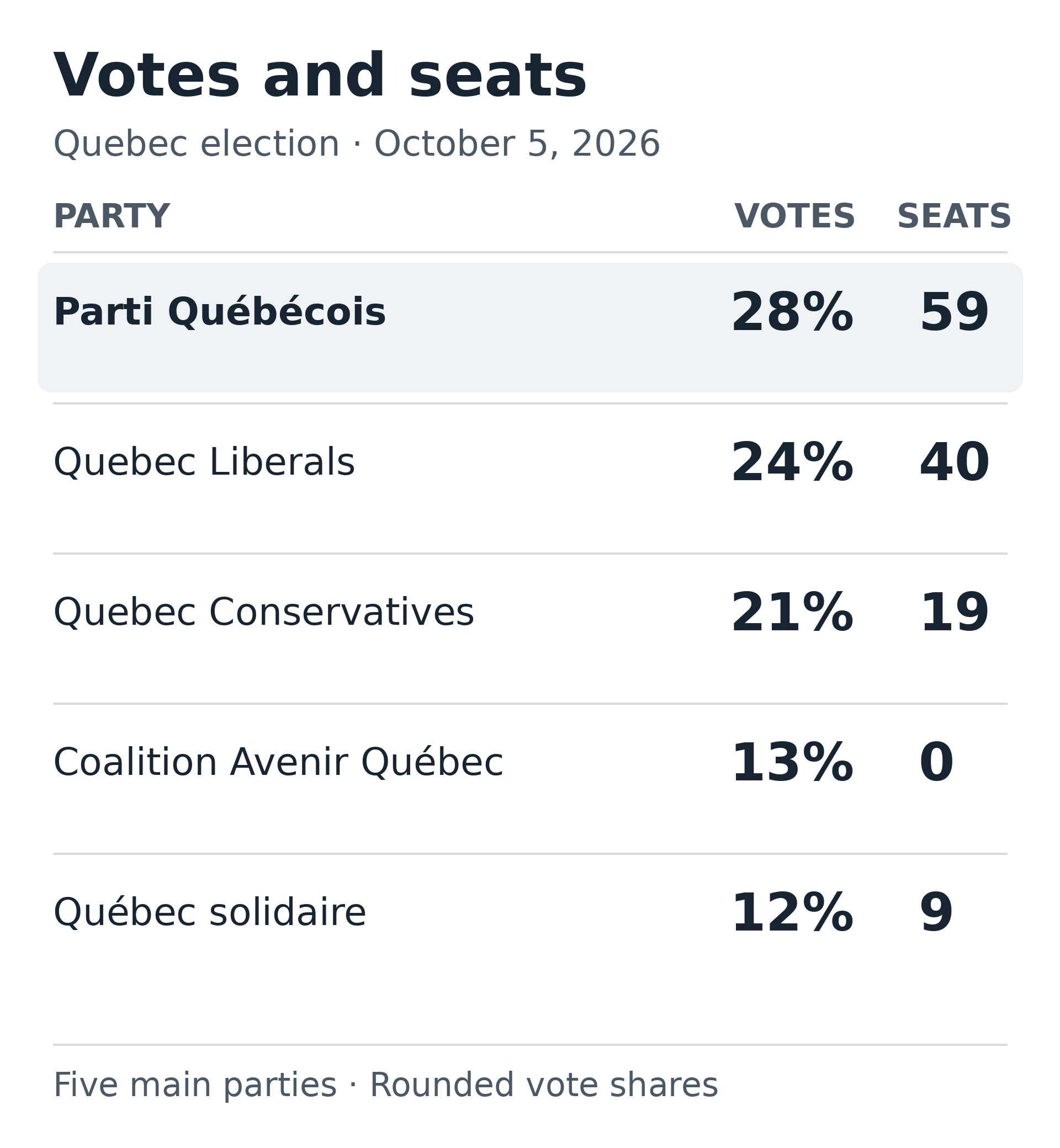
The PQ received little more than one vote in four and finished five seats short of a majority. The outgoing CAQ took roughly one vote in eight and lost every seat. First-past-the-post awards each riding to the candidate with the most votes. Enough local victories can give a party a large caucus even when most voters province-wide chose someone else.
The result is legitimate. Pooling every opposition ballot into an imaginary united party would tell us little about how those voters would actually behave. But winning the right to govern does not turn all those ballots into consent to separation.
McGill political scientist Daniel Béland told the AP that independence support remains around 30 per cent, low by historical standards, and described the election primarily as a rejection of the CAQ. That is an expert assessment, not a referendum tally or an explanation of every voter’s motives. Whatever change individual Quebecers wanted, they now have a government that also wants constitutional change.
A minority can still reopen the question
A minority government gives other parties leverage. It does not necessarily put sovereignty on the shelf. Québec solidaire is another sovereigntist party that could support a referendum. Its nine seats and the PQ’s 59 would make 68—above the 64 required for a majority in this Assembly.
That is a possible route, not an agreed coalition or a guaranteed vote. A formal coalition would not be essential if enough MNAs supported the proposal. Quebec’s Referendum Act allows a government-ordered referendum on a question approved, or a bill adopted, by the National Assembly. St-Pierre Plamondon says he would wait until the current U.S. president leaves office before holding one.
Sovereigntists are entitled to make their case, and Quebecers can reasonably want another say. The PQ’s Livre bleu sets out proposals for currency, constitutional institutions, citizenship and diplomacy. The test is whether those proposals can become a workable settlement. Which decisions could Quebec make itself, and which would depend on another government agreeing?
Even a successful referendum would leave negotiations and a constitutional amendment ahead; the Clarity Act specifically identifies borders, assets and liabilities, Indigenous rights and minority protections among the matters to address. A realistic plan must account for the terms other governments might refuse, the costs of the transition and how services would continue while it happens.
A difficult moment to change jerseys
Consider what Canada was defending before this election. On August 22, Prime Minister Mark Carney said he had suspended U.S. trade negotiations and recalled Canada’s negotiators rather than accept damaging terms. Protecting French language and culture was one of his stated red lines, alongside industrial interests and Canada’s freedom to make its own decisions.
That was Canada using its negotiating position to defend something central to Quebec. Sovereigntists should explain why an independent Quebec, bargaining alone with the same U.S. administration, would have more leverage to protect it. There is no automatic upgrade in bargaining power when a country becomes smaller.
French Canada also extends beyond Quebec, with communities in New Brunswick, Nova Scotia, Ontario and Manitoba. Their histories and political choices cannot be folded into Quebec’s sovereignty project. Protecting French language and culture is a Canadian responsibility, and the case for the country should include all of them.
Reuters has documented the U.S. president’s broad tariffs on Canadian imports and his calls for Canada to become the 51st U.S. state. The prospect of a friendlier bilateral deal needs more than confidence in the negotiating skills of a future Quebec government. What would Washington want in return, and what would Quebec be prepared to concede?
Carney’s stated response is to build domestic strength, diversify international partnerships and connect Canada more closely to itself and the world. That program will need to prove itself. Its underlying logic is understandable: a country trying to reduce its dependence on a powerful neighbour needs its own governments to get useful work done together.
There are also specific concerns about outside influence in domestic constitutional debates. On September 22, Canada’s Foreign Influence Commissioner acknowledged concerns about foreign influence activities directed at the Alberta referendum. That statement is not a finding of a foreign plot to break up Canada. Nor does Quebec’s election supply evidence of foreign interference: lawful sovereignty advocacy is domestic politics. Our October 4 article, Foreign Interference Needs One Canadian Standard, sets out the separate evidence test.
The Team Canada problem is more immediate. Quebec’s incoming government wants to explore starting its own team while Ottawa is trying to strengthen the one we have. That ambition cannot be assigned to every Quebecer. But it risks turning shared effort into an argument about who gets to take which pieces home.
Uncertainty has everyday consequences
History offers a useful warning without supplying a script for disaster. Federal Reserve researchers studying the 1995 referendum found that uncertainty reflected in Canadian-dollar options widened before the vote and narrowed afterwards. The finding concerns currency expectations, not a count of fleeing businesses. It shows that the question itself can have consequences before anyone answers it.
Brexit shows why the work after the vote matters. In its March 2024 review, the UK’s budget watchdog reported businesses facing extra costs from changed trade rules. Leaving the EU and seceding from Canada are different constitutional choices. The useful lesson is to account for the frictions a departure would create, rather than promise that taking control will make them disappear.
For ordinary people, the concern is what gets put on hold. An employer considering an expansion may want clearer rules before hiring. A worker deciding where to build a career may have another uncertainty to weigh. These are possible effects, not losses we can announce the morning after an election.
Businesses have other problems, too. Before the vote, Groupe Dynamite chief executive Andrew Lutfy explicitly separated his criticism of Quebec’s investment climate from the PQ and a possible referendum. Every stalled project cannot be dropped into the separatism column. The new government should be judged on what actually happens, including the work that proceeds.
Give people a reason to stay on the team
The case for Canada has to reach beyond warning Quebecers about the cost of leaving. Cooperation should help people find work, improve their communities and see a future worth sharing. Ottawa has to deliver on that promise, and federalists have to acknowledge where the federation frustrates people. A flag is a poor substitute for a government doing its job.
Quebec’s government can bargain hard, defend the French language and challenge Carney’s policies. Those are ordinary responsibilities within a federation. Canadians elsewhere should welcome a Quebec government that delivers for its people, while expecting a serious account of any plan to leave.
The same standard applies whether a separatist demand comes from Quebec or Alberta. A country shared by millions of people cannot be treated as the property of a provincial movement. Winning a provincial election is not a deed to Canada. Advocates of departure owe an account of the consequences for everyone whose future they propose to change.
Canada is greater than the sum of its parts when we use our combined strength to defend each other. Team Canada can handle an argument in the dressing room. Quebec and Alberta can challenge the game plan, and Ottawa has to earn their confidence. Once we’re on the ice against a tough opponent, we need to play for one another.
Working together is about more than answering Washington. Canada should aim to be a leading economy, carry more weight in the world and offer a better quality of life at home. Those ambitions require governments willing to work together and respect the rule of law, even when they disagree.
Canada’s governments have to show their people why staying on the roster makes them stronger.