How Canada Actually Comes Apart
A border can run through a town, a library - or a country's most important relationships. What would an actual separation mean for treaties, pensions, trade and everyday life?
CANADA, DIVIDED? — PART 3
Leaving Canada would take more than a referendum. From treaty rights and citizenship to pensions, pipelines and border crossings, somebody would have to keep everything working.
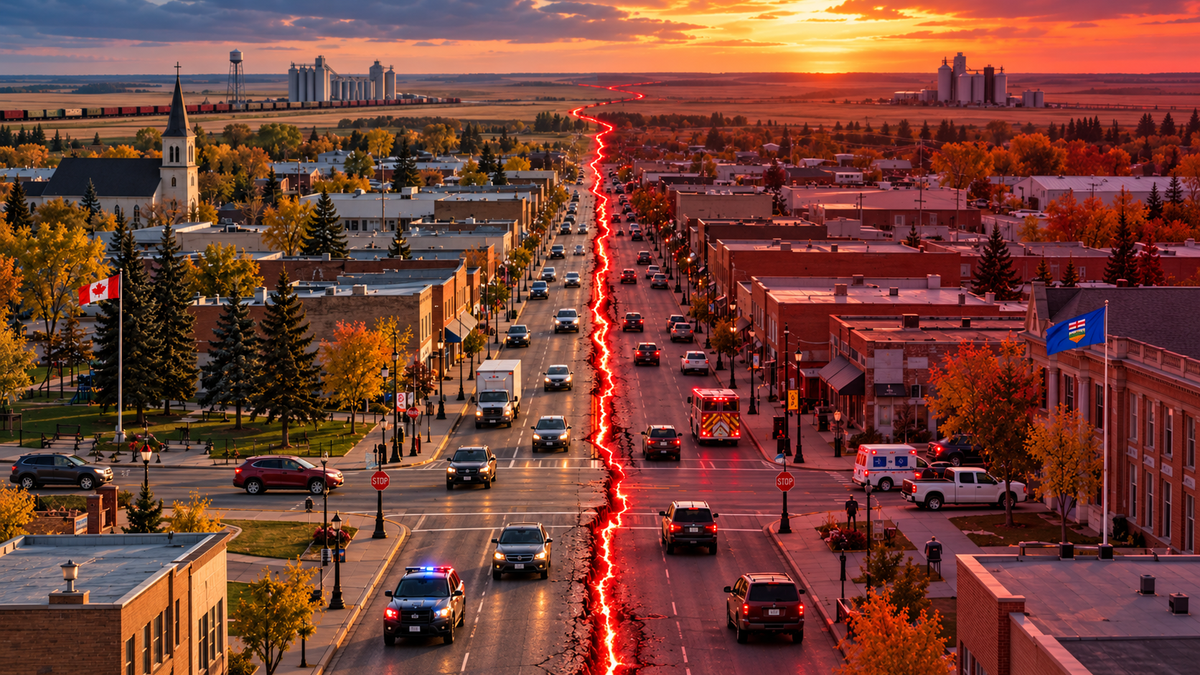
Lloydminster has a provincial border running right through town. On one side is Alberta, on the other Saskatchewan. Residents go about their day without stopping at a checkpoint, helped by a municipal charter approved by both provinces that allows one city to function across two legal jurisdictions.
Now imagine that same line becoming an international border. Would someone need travel documents to get to work across town? Who would collect taxes, regulate utilities or decide what happens when a vehicle crosses from one country into the other? Those aren't problems Lloydminster faces today. They're the sort of questions a separation agreement would have to answer.
We don't have to rely entirely on imagination. The Haskell Free Library and Opera House sits across the Canada–U.S. border, shared by Stanstead, Quebec, and Derby Line, Vermont. For more than a century, Canadians could use its American-side entrance without routine border inspection. U.S. authorities, citing security concerns, phased out that access in 2025. The library adapted, and its Canadian-side entrance was formally inaugurated in June 2026.
The people of those towns didn't stop being neighbours. They worked to preserve a shared institution. But the library's present rules require visitors to leave through the door they entered and prohibit cross-border family reunions inside. The neighbours are still neighbours. The rules have changed what being neighbours can look like.
That difference brings us to the last question in CANADA, DIVIDED?. On October 19, Albertans face a non-binding choice about remaining in Canada or beginning a legal process toward a possible future separation referendum. Our Alberta ballot explainer covers what this vote can decide. Here, the question is what would come afterward if a province ever pursued independence: how would its people, laws and everyday services actually carry on?
A vote can begin a negotiation. It cannot finish one.
The Supreme Court's 1998 Reference re Secession of Quebec ruled that a province cannot lawfully secede from Canada on its own. A clear majority for secession on a clear question would create a constitutional duty to negotiate in good faith. It would not give a province the power to dictate the terms or guarantee an agreement.
Parliament's Clarity Act gives the House of Commons a role in assessing whether a secession question and its result are clear. The Act distinguishes a direct choice about leaving Canada from a request for a mandate merely to negotiate. Monday's Alberta question concerns a possible future process; it is not itself the direct secession decision contemplated in the Act.
Any lawful departure would also require a constitutional amendment involving negotiations with Canada and the provinces. The Court deliberately left the precise amendment procedure dependent on what an eventual agreement would contain. Other governments, constitutional rights and minority protections would matter. There is no ready-made exit form waiting to be signed.
The map is already covered by treaties
Section 35 of the Constitution Act, 1982 recognizes and affirms existing Aboriginal and treaty rights. Those rights are not property belonging to the Alberta government, and treaty relationships with the Crown cannot be assigned to a new country as casually as a building or a stretch of highway.
Treaty First Nations have been saying so in the present Alberta debate. The Blackfoot Confederacy welcomed a May court ruling that quashed approval of a separate citizen-initiative petition and addressed the province's failure to consult First Nations. The Athabasca Chipewyan First Nation also publicly challenged the process on treaty and consultation grounds. The petition case is not the October 19 government referendum; Elections Alberta says verification proceeded under a limited stay while further steps awaited the Court of Appeal.
Nor has a court already drawn the borders of a hypothetical independent Alberta. The point is that Indigenous nations hold rights and interests of their own, and their participation can't be reduced to a provincial government checking a box. The Clarity Act expressly includes Indigenous rights, interests and territorial claims, possible boundary changes and minority protections among matters that negotiations would have to address. A proposed new country would inherit questions that go much deeper than its proposed name.
Where would the federal work go?
Passports, customs, federal taxation, border services, defence and immigration don't disappear when a new flag goes up. An independent government would have to decide which functions to operate itself, which to negotiate with Canada or other partners, and which to discontinue. It would need laws, people, equipment, secure systems and budgets ready to make those decisions real.
The University of Calgary's School of Public Policy supplied a useful inventory on October 14. Its review of federal functions in a separate Alberta examines work now spread across 239 federal departments, agencies and other entities, considering where the province already has related capacity and where it might need to expand, build, negotiate or do without. That is not a prediction that Alberta must create 239 new ministries. It is a way to see the actual work behind the word independence.
Albertans already operate sophisticated institutions and industries. Some responsibilities might be adapted from those capabilities; others would demand entirely different machinery. The hard questions are about transition: what must be running on day one, who is accountable when it fails, and what happens to people waiting for a decision or a payment in the meantime?
The household balance sheet
A referendum would not by itself cancel anyone's Canadian citizenship or pension. An actual separation settlement, however, would raise questions about nationality, residence and work rights, passports and the continuity of federal programmes. People who have built their lives on both sides of a provincial boundary would need answers more specific than a promise that everything would carry on.
Workers outside Quebec generally contribute to the Canada Pension Plan, while Quebec has its own plan inside Canada. That shows two pension systems can coexist; it doesn't provide an automatic formula for dividing assets, actuarial liabilities, past contributions or future benefits between Canada and a new sovereign state. Old Age Security, federal public-service pensions and veterans' benefits involve additional rules. A workable transition would have to explain those differences rather than treating every retirement payment as one account.
Currency is another decision that could sound straightforward until the details arrive. A new state could consider using the Canadian dollar, introducing a currency or seeking a negotiated arrangement. Yet using dollars doesn't guarantee control over interest rates or emergency financial support. The Bank of Canada's lender-of-last-resort arrangements apply within defined institutional conditions; access for banks in an independent Alberta could not simply be assumed.
The public balance sheet would also need a negotiation. The Clarity Act identifies assets and liabilities that must be addressed, along with boundaries and rights. Federal facilities, infrastructure, debt and long-term obligations do not arrive with price tags showing an uncontested provincial share. Credible proposals need valuation methods and a plan for who pays the bills while those arguments are settled.
Resources are not the same as routes to market
Alberta's oil, gas, farms and skilled workforce would not cease to exist after separation. Those economic strengths are real. So are the relationships required to turn production into revenue: buyers, pipelines, railways, power connections, ports, regulators and enforceable contracts beyond provincial borders.
The Canada Energy Regulator's review of 2025 trade documents the pipelines, rail and marine routes and international electricity lines connecting Canada and the United States. An independent Alberta might negotiate workable arrangements to preserve its commerce. It could not assume that every domestic transit right or international trade commitment would simply follow it out of Confederation.
Within Canada, the Canadian Free Trade Agreement governs important aspects of internal trade, services and labour mobility. Crossing from Alberta to Saskatchewan today is not the same legal or commercial event as crossing from one country into another. Stanstead's library may be a small comparison, but it shows why the details matter: one changed border rule can force people to rebuild a route they had used for generations.
Put the economic claims through the same test
The University of Calgary's Alberta separation study was commissioned by the provincial government and examines possible fiscal and economic results under different assumptions. Its authors do not claim one certain outcome. Much would depend on negotiations, public services, currency choices, trade conditions and the decisions of businesses and households.
Supporters of separation may see opportunities for different taxes, spending and regulation. Opponents point to the price of new institutions, uncertainty and the risk of disrupting commerce. Neither side should get to present a favourable scenario as a guaranteed result. A useful calculation distinguishes one-time transition costs from continuing costs and identifies who bears them, when and under which agreements.
Quebec's referendum periods offer history, not a laboratory in which every economic variable stood still. It would be careless to attribute every headquarters move or investment decision to constitutional uncertainty. It would be just as careless to pretend the prospect of new borders and financial rules couldn't affect a lender or an employer considering a long-term investment. Give readers the project evidence, the financing terms and the assumptions. Let the argument earn its numbers.
What holds a country together
The discussion began with strategic interests abroad and moved through organizations campaigning inside Alberta. It ends with people whose lives run across those political lines: treaty holders, workers, families, businesses and neighbours. They may never have appeared at a rally, but any actual separation would reach their doorsteps, too.
Canada has plenty of disagreements worth having. Federalism gives us room to have them, challenge governments and improve how our shared institutions work. A country doesn't need every province to agree on every policy; it needs ways to settle disputes while respecting the rights and daily lives of the people involved. Those arrangements are sometimes frustrating, expensive and overdue for repair. They are also the reason so much can happen across a provincial border without anybody noticing the line.
In Lloydminster, two provinces found a way to run one city. At the Haskell library, Canadians and Americans found a way to keep one building accessible after new restrictions forced a different entrance. Neither story settles the constitutional debate. Both show that borders are made of laws and decisions as much as geography, and that neighbours still have to live with the consequences.
Canada isn't held together because we always agree. It's held together by what we build across our disagreements — and the promises we keep after the speeches end.
Editor's note: This is Part 3, the final instalment of CANADA, DIVIDED?. Part 1, Who Benefits From Breaking Up Canada?, examined outside strategic interests and the limits of what the evidence establishes. Part 2, Who Is Behind Alberta's Independence Campaign?, examined the organizations, political connections and financial-accountability questions in the Alberta movement. This finale addresses the constitutional, treaty, economic and practical responsibilities any attempted separation would entail. Our separate October 19 Alberta referendum explainer covers the ballot itself.