Gas Prices Rise Like a Rocket and Fall Like a Feather. The Data Behind the Sign Matters Too.
Gasoline prices are set locally, but the market intelligence behind them can be national. A new Competition Bureau agreement puts new limits on what fuel retailers can know about their rivals.
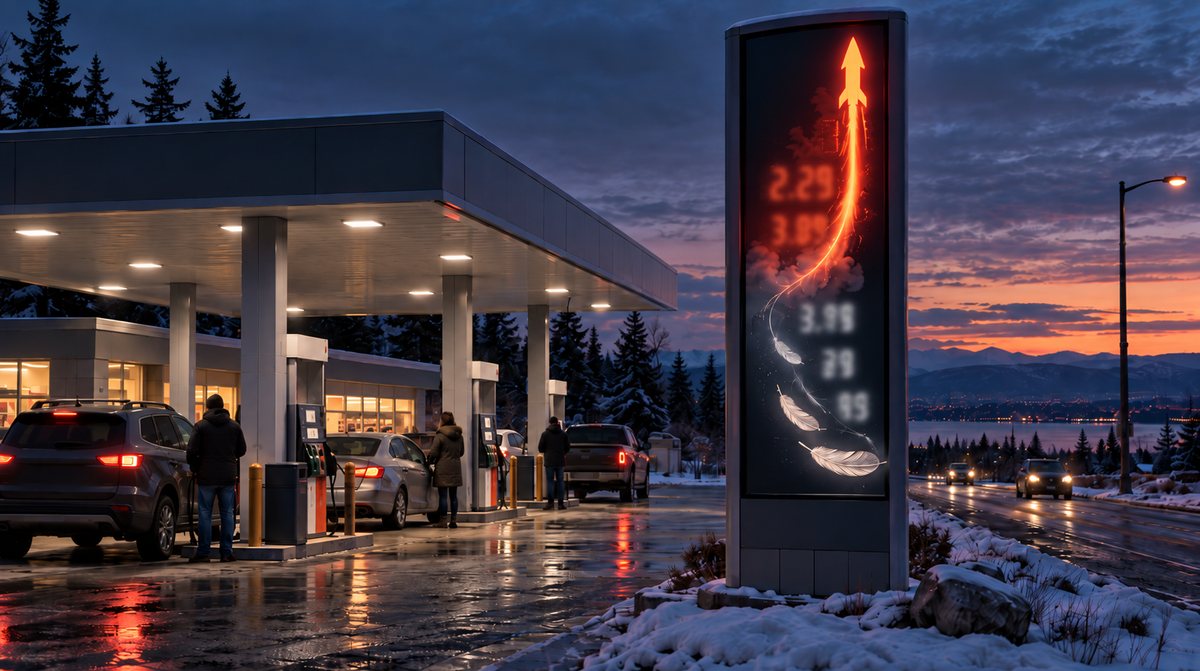
Every driver has seen it: one station raises its price, and before long the numbers around the neighbourhood seem to follow. The Competition Bureau’s latest case offers a rare glimpse at the information sitting behind those roadside signs — and where regulators think competition can start to weaken.
Gasoline has an annoying habit.
Prices can drift down a cent or two for days, then jump several cents before you have finished wondering whether you should have filled up yesterday. Economists even have a name for part of it: the “rocket and feather” effect.
The Bank of Canada describes gasoline prices as sometimes following oil prices upward quickly, like a rocket, while taking longer to follow them back down. Consumer shopping behaviour and the degree of competition among wholesalers and retailers can both play a role.
Gasoline also matters well beyond the service station. In August, gasoline prices were 22.8% higher than a year earlier. Headline inflation was 3.0%; without gasoline, it was 2.4%. Gasoline does not explain every affordability problem, but the number glowing above the neighbourhood station can hit household budgets and national inflation statistics at the same time.
That makes something the Competition Bureau announced this week worth a closer look, because the story is not only about what gas stations charge. It is also about what they know about one another.
Economics 101 wasn’t wrong
The textbook version of competition is simple. Two stations sell essentially the same litre of gasoline. One charges less. Price-sensitive drivers choose the cheaper station, the higher-priced station loses business, and it has an incentive to cut its price.
That still happens. The Competition Bureau says stations often try to meet or beat nearby posted prices because drivers are sensitive to price. That is one reason stations across the street from one another so often display nearly identical numbers. Matching a competitor’s posted price is not, by itself, evidence of anything illegal.
But gasoline is also a repeated local game. The same stations watch one another every day, and everybody can see the giant price sign from the road. If one retailer cuts its price, rivals can follow rather than surrender customers. Margins fall. If one station raises its price and competitors follow, though, the market can move upward very quickly.
Economists have studied that behaviour. Michael Noel’s 2007 study of 22 Toronto service stations observed every 12 hours for 131 consecutive days found strongly asymmetric, synchronized cycles consistent with what economists call Edgeworth price cycles: prices could jump sharply, then be gradually undercut on the way back down.
The study used Toronto data from 2001, so it does not prove every Canadian gasoline market works that way today. It does help explain why drivers can look at nearby stations and wonder why the market does not always resemble the neat diagram from an introductory economics textbook.
The economics are still there. They are simply playing out over and over among competitors who can constantly see what the other guy is doing.
Seeing the price is one thing
Seeing what happens behind the price sign is another.
On September 24, the Competition Bureau announced a legally binding consent agreement with Kalibrate Canada over its Kalibrate Market Intelligence, or KMI, product.
Before the agreement, the Bureau says KMI covered more than 7,000 Canadian fuel stations and the majority of retail motor-fuel sales volume in the country. Participating retailers could receive information about competing stations, including fuel sales volumes, spot prices and station characteristics. Some of it was available station by station.
That is rather different from driving past a competitor and seeing $1.579 on the sign.
A posted price tells you what your competitor is trying. Detailed sales information can help tell you whether it worked. Did the lower price produce more volume? Did customers stay put after an increase? How did nearby stations respond?
The Bureau concluded that this extra visibility made competitors’ actions easier to predict and increased the risk of coordination, potentially weakening the incentive to compete aggressively. That is where an obscure market-data case becomes a consumer story.
What changes now
Kalibrate can still provide market intelligence. What changes is how current and how specific that information can be.
Under the consent agreement described by the Bureau, one fuel retailer cannot receive confidential or competitively sensitive information about an individual competitor. Aggregated information can still be provided when it is structured so the performance of a specific retailer cannot be determined.
There is also now a clock: KMI information cannot cover periods shorter than a month and cannot be distributed until at least 10 business days after the end of the reporting period.
The data does not disappear. It becomes less immediate and less specific.
That reflects a broader competition principle. Aggregated historical information can help businesses understand a market. Detailed, current information about an identifiable rival can also make that rival easier to monitor. When competitors can quickly see who departed from the prevailing behaviour — and whether it worked — the incentive to act independently can change.
This is not a price-fixing case
That distinction matters.
The Bureau began investigating Kalibrate in February 2024 partly because of concerns about its separate Kalibrate Fuel Pricing, or KPR, software, which can automate pricing decisions and make recommendations.
After reviewing information obtained through a court order, the Bureau says it did not uncover evidence that KPR used one retailer’s confidential information to determine pricing recommendations provided to competing retailers in Canada. The concern that ultimately produced this week’s agreement centred on KMI and the sharing of detailed competitor information.
Nor does seeing neighbouring stations move their prices together prove price-fixing. The Competition Bureau has prosecuted actual gasoline price-fixing cases, including cases in Quebec and Ontario. Price-fixing requires evidence that competitors agreed to set prices; similar prices alone are not enough.
The Bureau’s Kalibrate statement carries another important qualification: its conclusions were not findings of fact or law tested before a court or tribunal, and the statement does not itself establish unlawful conduct by any party. Kalibrate cooperated with the investigation and entered into the consent agreement.
So this is not evidence of a national gasoline-price conspiracy. It is evidence that Canada’s competition regulator believes too much detailed information between competitors can itself weaken the competitive process.
That is narrower than a conspiracy story — and considerably more interesting.
National data, local competition
Gasoline prices are shaped by a peculiar combination of huge global forces and very local decisions.
Crude prices matter, as do refinery capacity, wholesale markets, transportation costs, exchange rates, taxes and regional supply conditions. The Competition Bureau identifies all of them as parts of the price Canadians eventually see at the pump.
But the retail contest is local. Most drivers are not choosing between a station in Halifax and one in Calgary. They are deciding between this station, the one across the street and another one a few kilometres down the road.
That is what makes the Kalibrate case unusual: the information network was national, while the competition happens neighbourhood by neighbourhood.
More than 7,000 stations could feed a large national market-intelligence system, while the contest for a customer’s tankful remained local. The agreement now puts more distance between those two things.
One-tenth of a cent is not nothing
There is one number in the Bureau’s statement that puts the scale into perspective.
It estimates that an average increase of just one-tenth of a cent per litre over a year translates into more than $40 million in additional direct costs for Canadians.
That does not mean KMI raised Canadian gasoline prices by a tenth of a cent, or by any particular amount. The Bureau makes no such claim. It tells us something more basic: when Canadians buy enough gasoline, tiny differences become very large numbers.
The effects do not necessarily stop at the pump. The Bank of Canada notes that higher gasoline prices can raise costs elsewhere in the economy and contribute to inflation. That is why gasoline remains such a visible affordability barometer: Canadians see the price every day, written in giant illuminated numbers beside the road.
Now comes the useful test
The Competition Bureau has changed the rules governing a major source of gasoline-market intelligence. It has not promised cheaper gasoline.
Oil prices will still move. Refineries will still go offline. Taxes will still differ by province. Supply disruptions will still happen. Retailers will still watch the giant price signs across the street and respond to one another.
The useful question is whether they now have to do more of that responding independently, without the same detailed view into how competitors are performing behind the sign.
That gives Canadians something worth watching. Does local competition become more aggressive? Do pricing patterns change? Does delayed, aggregated information make it harder to monitor a rival’s strategy? Or does almost nothing noticeable happen?
Those are questions we can answer with evidence over time rather than conclusions we need to invent today.
The Competition Bureau has already drawn one useful line: seeing your competitor’s posted price is part of competing.
Seeing enough of their private performance data to know exactly how that price worked can be something else.
And when gasoline has a habit of rising like a rocket and falling like a feather, that is worth understanding.