Diversification Needs a Shiploader. Canpotex Is Spending $500 Million on One.
Canpotex is modernizing the Neptune potash terminal in North Vancouver. The project is a reminder that export diversification depends on railcars, conveyors and port reliability as much as new customers.
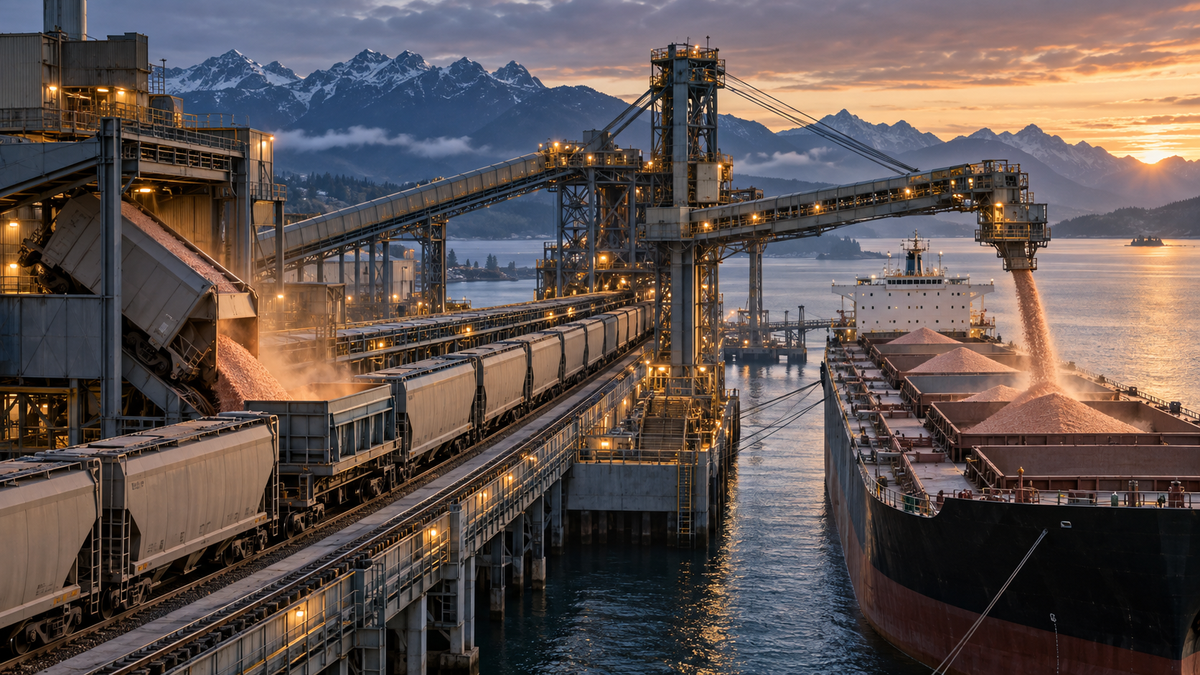
Canada can sign trade agreements and court new customers. But when millions of tonnes of Saskatchewan potash have to reach farmers overseas, diversification turns into a logistics problem: railcars have to arrive, the terminal has to work and the ship has to load on time.
Canpotex put a very large number on that problem Friday: C$500 million. The Saskatoon-based potash exporter announced a C$500-million investment in Neptune Bulk Terminals at the Port of Vancouver, which it calls the largest supply-chain investment in the company’s history.
The work is decidedly physical. The project will replace and modernize shiploaders, conveyors and the dumper pit used to unload railcars and load vessels. Canpotex says construction should be finished in 2028 while customer shipments continue, supporting 400 to 500 construction jobs along the way. It estimates that 85 to 90 per cent of project spending will go to Canadian suppliers and contractors.
Canpotex’s public announcement puts the emphasis on reliability, resiliency and long-term performance rather than attaching a specific tonnage target to the upgrade. That distinction matters. Spending $500 million on export infrastructure does not automatically create $500 million in new exports. The test is whether the machinery helps Canada move what it already sells more reliably — and gives the system more room to support future business.
The port is part of the product
Canpotex markets potash produced by Nutrien and Mosaic and says it moves more than 15 million tonnes of Canadian potash each year to customers in more than 40 countries. That makes the journey from Saskatchewan to tidewater part of the commercial product.
Most of the company’s potash travels west by rail before reaching marine terminals, and Canpotex says the majority of its potash moves through Neptune. Its five largest overseas markets — Brazil, China, India, Indonesia and Malaysia — account for about three-quarters of annual Canpotex exports.
Potash is also more than an obscure industrial commodity. Ottawa includes it on Canada’s critical-minerals list, and Saskatchewan describes it as an essential fertilizer. The province says potash exports were worth $9 billion in 2025. When a conveyor stops or a ship cannot load, the problem does not remain beside Burrard Inlet. It reaches back through rail networks and Saskatchewan mines and forward to farmers buying fertilizer overseas.
Canada has already seen what a bottleneck costs
Neptune’s importance became difficult to ignore during the 2023 British Columbia port dispute. Canpotex said at the time that roughly 70 per cent of its potash exports were moving through Neptune, and when the disruption hit, the company withdrew offers for new potash sales because it could no longer predict export capacity through Vancouver.
The disruption was large enough to reach Parliament. In testimony to the House of Commons trade committee, Canpotex said about 500,000 tonnes of planned potash shipments were diverted or delayed, and that it had to rely more heavily on U.S. ports. Statistics Canada later reported that exports leaving British Columbia marine ports fell 23 per cent in July 2023, with potash among the notable declines.
That episode is the useful context for the Neptune investment. Canpotex already has alternatives in its network, including other Canadian and U.S. terminals, and that redundancy matters. But rerouting cargo is not the same thing as making the main route dependable. A resilient supply chain needs both.
This is what diversification looks like after the announcement
Canpotex is an overseas marketing and logistics company: it sells and delivers Nutrien and Mosaic potash to markets outside Canada and the United States. Its customer base is therefore already international. For Canpotex, the diversification question is not simply whether Brazil, India or Indonesia can be found on a sales map. It is whether Canadian infrastructure can reach those customers reliably enough to keep the business.
That is a practical form of economic sovereignty. It does not require Canada to do everything alone; ships, railways, ports, foreign buyers and international partners remain part of the system. The question is whether enough of the critical route is reliable, competitive and under conditions Canada can influence.
The Neptune project gives us something concrete to measure. Canpotex says the work will replace major terminal equipment without interrupting customer shipments, and it expects most project spending to land with Canadian suppliers and contractors. Its wider supply chain includes more than 8,500 custom railcars, almost all built in Hamilton. That is more tangible than a diversification slogan.
Now comes the scoreboard
The groundbreaking is the beginning of the story, not the result. By 2028, Canpotex should be able to answer several practical questions: Did construction finish on schedule? Did shipments continue without material disruption? Did the expected Canadian supplier share materialize? Did the new equipment improve reliability and terminal performance? Did overseas volumes and destination diversity hold up or grow?
The harder test may come with the next rail stoppage, port disruption or global trade shock. If the system has more room to absorb that pressure, the investment will have done more than modernize equipment — it will have strengthened the export route itself.
Those are the measures that will tell us whether a $500-million announcement became useful capacity. Trade diversification is often drawn as lines on a map. For Saskatchewan potash, one of those lines runs through a railcar dumper, a conveyor and a shiploader in North Vancouver.