Canada Has Nearly $500 Billion in Investment and Financing Commitments. Now Comes the Hard Part.
Canada’s first Investment Summit came with nearly $500 billion in investment and financing commitments. The real test is whether Canada can turn that capital into projects that actually get built.
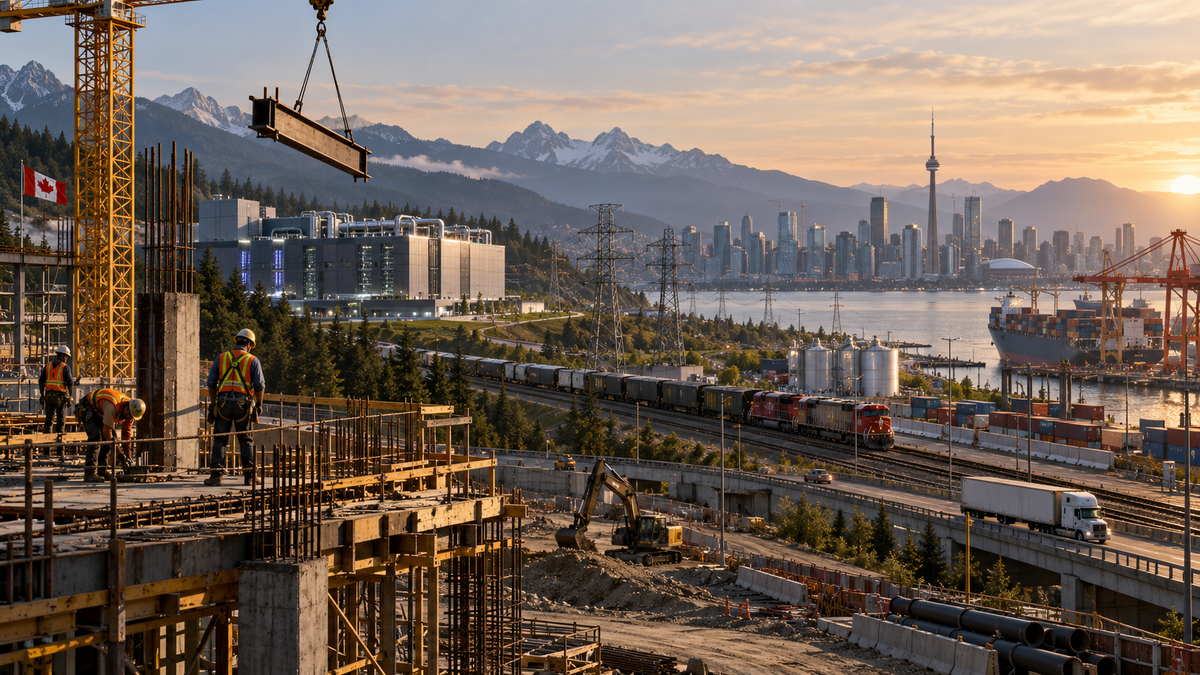
Canada’s first Investment Summit produced enormous numbers. The more important question is whether the country can turn capital commitments into mines, factories, infrastructure, technology and lasting productive capacity.
For weeks, the number hanging over Canada’s first Investment Summit was $1 trillion — Ottawa’s five-year ambition for total public, private and institutional investment in Canada. It is large enough to dominate a headline and broad enough to require some unpacking.
The useful question was always simpler: would serious capital actually move toward Canadian projects, and would those projects eventually get built?
After the Toronto summit, there is finally something more substantial to measure. The federal government says the event laid the groundwork for new investment and accelerated negotiations already underway, while grouping nearly $500 billion in new investment commitments under the summit. The details are important: almost $100 billion is associated with pension funds, insurers and institutional investors; nearly $325 billion is bank financing; and more than $14 billion is to be invested or mobilized by investment funds. Investors from nearly 30 countries attended, collectively managing more than $100 trillion. Prime Minister’s Office
The attendance number makes for good summit theatre. The commitments are more consequential. But nearly $500 billion in investment and financing commitments is not the same thing as nearly $500 billion already sunk into Canadian concrete, steel, equipment and software.
First, separate the money
CPP Investments and Brookfield Asset Management created the Maple Fund, a joint investment framework capable of generating and executing up to $50 billion in equity investments in Canadian infrastructure and strategic industries over an initial five years. Prime Minister’s Office
PSP Investments expects its Canadian pension capital to grow by 30 to 40 per cent and cross $100 billion over the next few years, after investing $10 billion in Canada during its most recent fiscal year. Ontario Teachers’ Pension Plan has separately set an objective of investing another $10 billion in Canada by the end of 2027. PSP Investments · Ontario Teachers’ Pension Plan
The banks are offering something different again. TD launched a $150-billion, five-year commitment covering new lending, underwriting, advisory work and other financing activities in energy, critical minerals, defence, aerospace, digital technology, AI and infrastructure. Scotiabank has committed more than $100 billion in financing over five years, while BMO plans to mobilize up to $70 billion over 10 years. CIBC and RBC announced smaller targeted initiatives. TD Bank · BMO · Prime Minister’s Office
Those distinctions matter. Financing is what allows a mine, factory, transmission line, data centre or port to move toward construction, but money available to finance projects is not money already invested in them. Some of the largest programs were also announced as the summit approached rather than appearing spontaneously during two days in Toronto.
The summit itself was partly a matchmaking exercise. Reuters reviewed an investor prospectus containing more than 160 opportunities, ranging from concepts to shovel-ready projects, and reported that government officials expected some major deals resulting from those discussions to take 12 to 18 months to materialize. Reuters
There is another useful distinction buried in Canada’s investment numbers. Foreign direct investment has been rising, but Reuters found much of the recent increase has come through mergers and acquisitions or reinvested earnings by foreign companies already operating here. Greenfield investment — money going into genuinely new factories, facilities and productive capacity — has not shown the same dramatic increase. Reuters
That gets closer to the real economic test. Buying an existing company can move a great deal of capital. Building a new plant, mine, data centre, transmission line or processing facility adds productive capacity that was not there before.
The proposed Bell Saskatchewan AI hub illustrates both the scale of the opportunity and the distance still to travel. Bell and Saskatchewan have signed a non-binding memorandum of understanding for an expansion that could ultimately create a 1.2-gigawatt AI infrastructure hub. Ottawa puts the potential capital investment at $52.5 billion, but the expansion would proceed in phases as customers are secured and remains subject to commercial agreements, permits, approvals and environmental requirements. Bell · Prime Minister’s Office
If that reaches full buildout, it would be an enormous Canadian investment. For now, it remains a very large proposed development with important conditions attached. There is nothing wrong with recognizing the potential. There is also no reason to confuse a memorandum with a finished asset.
The harder problem is converting capital into productive capacity
This is where the Investment Summit becomes more interesting than its headline total. Ottawa is not only trying to attract investors; it is changing some of the conditions that influence whether capital goes into new Canadian projects.
The most immediate example is the Productivity Mega Deduction. Finance Canada is proposing permanent immediate expensing for a much broader range of depreciable property, with roughly two-thirds of capital investment potentially qualifying. The proposal would generally apply to eligible property acquired on or after September 15, 2026, and draft legislative proposals have been released. Finance Canada
Finance Canada says accelerated capital-cost measures announced in Budget 2025 reduced Canada’s marginal effective tax rate on new business investment from 15.4 per cent to 13.0 per cent, and estimates the proposed Mega Deduction would reduce it further to 6.4 per cent, compared with 16.9 per cent in the United States. Finance Canada
That 6.4 per cent number is not Canada’s corporate income-tax rate. The marginal effective tax rate is an economic measure designed to estimate the tax burden on an additional investment after corporate taxes, capital-cost allowances, investment incentives and other parts of the tax system are taken into account.
That can affect the economics of deciding where to place new machinery, production equipment, a mine expansion or a data centre. But the measure is still proposed legislation, and tax treatment is only one piece of an investment decision. Projects also need customers, infrastructure, labour, financing and regulatory approval.
That last requirement has long been a source of concern around major Canadian projects. Carney used the summit to put a new standard around the government’s proposed reforms: “One project. One review. One year.” Prime Minister’s Office
The distinction between a federal target and a complete project timeline matters. Provincial and territorial jurisdiction does not disappear, and environmental requirements, Indigenous rights and Crown consultation obligations continue to apply.
Long approval timelines can increase financing and carrying costs. Poorly executed acceleration can create different costs if decisions are overturned or assessments and consultation have to be repeated. The useful measure will therefore be whether projects begin receiving decisions that are faster, more predictable and durable.
That record will take time to establish.
Capital also raises an ownership question
The investment discussion can quickly become dominated by how much money is coming in. There is another question worth following: who owns part of what gets built and who participates in the return?
Ottawa’s Indigenous Loan Guarantee Program is now a $10-billion federal initiative intended to help Indigenous groups obtain lower-cost financing for equity ownership in major projects. In June, federal and Ontario loan-guarantee programs supported approximately $715 million in financing that will allow seven Williams Treaties First Nations to eventually acquire a significant minority interest in the Darlington New Nuclear Project. Finance Canada
That gives Indigenous participation an economic dimension beyond consultation alone. For projects operating for decades, equity can mean long-term revenue and ownership rather than participation only during approval and construction.
Another version of the ownership question appears in Ottawa’s proposal for Canada’s four largest airports.
The federal government says it will seek private investment through long-term concessions to operate Toronto Pearson, Montréal-Trudeau, Vancouver International and Calgary International while retaining public ownership of the underlying land and assets. Ottawa says tens of billions of dollars raised through the process could be reinvested in regional airports, local transportation and a sovereign broadband backbone. Prime Minister’s Office
There is already interest from Canadian pension funds and international infrastructure investors. Labour organizations have raised concerns that commercial operators could eventually increase costs for passengers. Reuters
That means the eventual concession agreements will matter far more than the announcement. The relevant questions will include what rights are transferred, for how long, how pricing is regulated and how much value Canadians receive in exchange.
Asset recycling can release capital from mature infrastructure for use elsewhere. It can also exchange future revenue for capital today. Which description ultimately fits Canada’s airport plan will depend on the terms.
The Canada Strong Fund brings another model into the mix. Announced in April with an initial $25-billion federal contribution, it is intended to invest alongside private capital in Canadian projects and companies on a commercial basis. The government has said the fund will be professionally managed and structured as an arm’s-length independent Crown corporation, while details of its mandate and governance continue to be developed. Prime Minister’s Office
That differs from a conventional subsidy because an equity investor can participate in gains as well as losses. Whether the model ultimately benefits Canadians will depend on governance, investment discipline, political independence and actual financial performance.
Taken together, the pieces begin to show a broader strategy: pension capital, private investment funds, bank financing, Indigenous equity mechanisms, proposed tax incentives, regulatory changes, asset recycling and direct public investment.
In practical terms, Canada is trying to improve the path between identifying a worthwhile project and operating a productive asset. That means finding projects investors will finance, improving their economics, making regulatory decisions, assembling capital and eventually getting something built. The longer-term Canadian questions then become what remains here — ownership, employment, intellectual property, infrastructure, supply-chain capability and investment returns.
The trade dispute changed the urgency, not the underlying problems
The Canada-U.S. trade conflict is an important part of the summit’s context. Ottawa has explicitly tied its economic strategy to resilience and diversification, while seeking deeper investment and commercial relationships beyond the United States. Reuters reported that attracting investment has become more important as Canada deals with U.S. tariffs and tries to broaden its international economic relationships. Reuters
But most of the economic problems this strategy is trying to address predate the current dispute. Canada was already wrestling with productivity growth, lengthy major-project processes, infrastructure requirements and the challenge of attracting more greenfield investment. The trade conflict has increased the urgency around those questions rather than creating them from scratch.
Diversification also does not mean replacing the United States or retreating from international investment. Canada remains deeply integrated with the American economy while seeking additional investors and markets elsewhere. Nearly 30 countries were represented at the Toronto summit. Prime Minister’s Office
The objective is more room to manoeuvre: more customers, more investors and more markets when economic conditions change.
Now count what gets built
The first Canada Investment Summit left behind an extraordinary collection of numbers: nearly $500 billion grouped by Ottawa under investment commitments, including nearly $325 billion in bank financing; a Maple Fund capable of up to $50 billion in equity investment; a potential $52.5-billion Saskatchewan AI project; a proposed 6.4-per-cent marginal effective tax rate on new business investment; and a $25-billion Canada Strong Fund — all beneath the government’s five-year ambition to catalyse more than $1 trillion in total investment. Prime Minister’s Office
There is enough potential capital in those numbers to materially increase Canada’s productive capacity. But productivity does not rise because financing is announced. It rises when businesses invest in equipment, technology and productive assets, when new infrastructure enters service and when companies have the capacity to produce more value from the people and capital available to them.
That makes the next stage less spectacular than an investment summit but much easier to measure.
How much capital is actually deployed through the Maple Fund? Does the Bell Saskatchewan proposal move from a non-binding memorandum into construction? Do the proposed tax changes alter investment behaviour? Do faster federal reviews produce faster and legally durable decisions? Do Indigenous loan guarantees translate into substantial long-term ownership? What are the economics of the airport concessions once the contracts are available? And does the Canada Strong Fund ultimately produce both commercial returns and identifiable Canadian investment?
Some of those answers will take years. That is appropriate. The investments themselves are supposed to last for decades.
Canada’s Investment Summit has given us a clearer picture of the capital available and the policy machinery being assembled around it.
The next measure is what gets built.