Helium-3 From the Moon? Canada Already Has It.
Canada’s helium-3 business connects nuclear power, quantum refrigeration and international trade. An Edmonton manufacturer explains how it buys the gas.
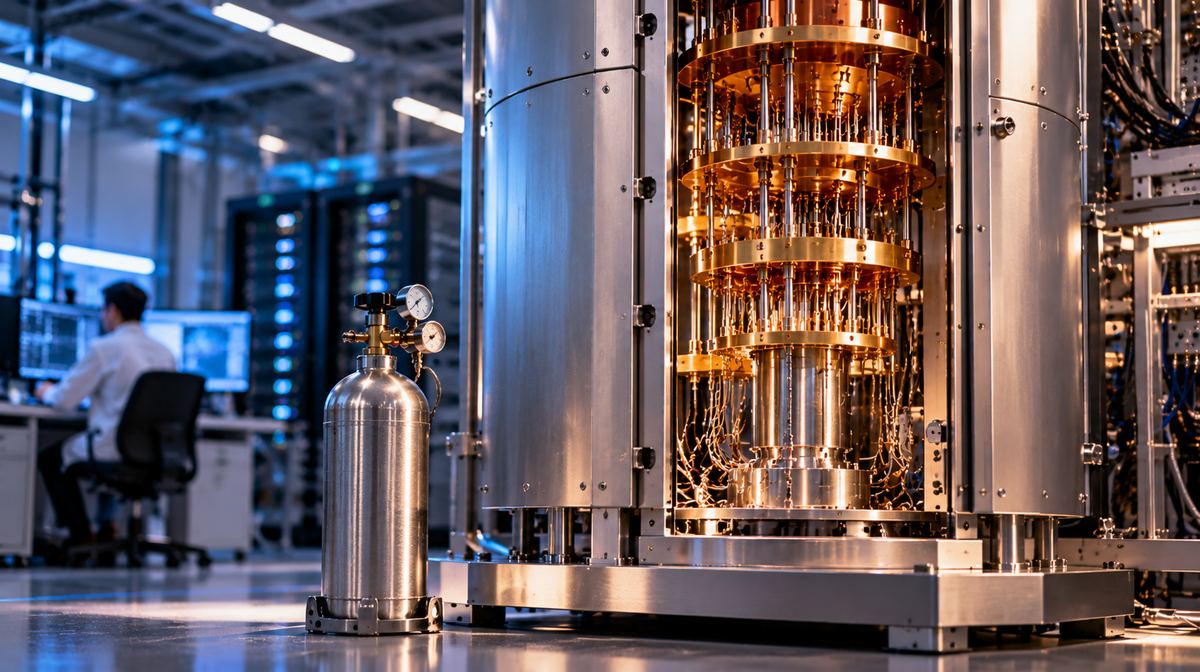
A rare gas recovered at Darlington helps machines in Edmonton reach temperatures near absolute zero. As companies pursue a lunar supply, Canada has an industry taking shape much closer to home.
The search for helium-3 has engineers designing equipment to sift the soil of the Moon. In Ontario, the same rare isotope is being recovered at a nuclear power station whose everyday business is generating electricity.
In May, NASA awarded Seattle-based Interlune US$6.9 million to develop and test lunar resource-prospecting technology. The planned equipment would collect lunar soil, release gases and measure what comes out. Helium-3 is among the resources the agency identifies. NASA wants future missions to use more of what they find on the Moon, reducing the supplies they must bring from Earth.
At Darlington, about 100 kilometres east of Toronto, recovery is already under way. Laurentis Energy Partners, an Ontario Power Generation subsidiary, extracted its first batch of helium-3 in November 2021. Its source is material stored at the nuclear station, with a useful second life waiting inside it.
From reactor to refrigerator
Darlington’s CANDU reactors use heavy water. Tritium removed from that water is stored, and as it decays it becomes helium-3. Specialized equipment recovers the gas. The result is a stable, non-radioactive isotope with uses that reach well beyond the power station. Laurentis lists applications in research, security, medical imaging and quantum technology.
One of those applications leads to Edmonton, where Zero Point Cryogenics builds dilution refrigerators. A federal account of the company’s work with the National Research Council traces its development from an academic laboratory into a manufacturing facility, refining and customizing machines along the way. The company also secured a testing contract with the Department of National Defence.
These refrigerators take cooling to temperatures near absolute zero. Inside them, helium-3 works with the more common helium-4 to remove heat. Manufacturer Bluefors explains how the mixture produces cooling and the helium-3 returns through the system. The gas circulates rather than being burned as fuel, allowing it to be reused. Each new machine still needs its initial supply.
For some quantum hardware, that cold is essential. Canada’s quantum-computing roadmap identifies the need for helium-3 cooling and flags scarcity and controlled distribution as supply-chain challenges. Different quantum technologies have different requirements, but for the manufacturers whose machines use helium-3, access to the gas is part of getting a product into a customer’s hands.
Canadian gas, an international business
The gas may originate in Ontario, but Zero Point’s purchase does not begin with an order to Laurentis. Christopher Cassin, Zero Point’s chief executive, told Nasty Canuck in written answers that his company cannot buy directly from the producer. It purchases helium-3 on the open market, including Canadian-produced material obtained through international sellers.
“Zero Point has been able to negotiate prices with those international sellers and receive helium-3 within required delivery times,” Cassin said.
Behind those purchases is a business that extends beyond recovering the isotope. Under the Laurentis–Air Liquide partnership announced in December 2021, Air Liquide undertakes further purification, packaging and worldwide distribution. Those are the steps that help turn recovered gas into a product ready for customers.
Cassin’s account describes orders arriving when needed through that wider market. He did not identify Zero Point’s international sellers or disclose purchase volumes and negotiated prices. The public partnership announcement does not spell out customer allocations either. His experience offers a view of one Canadian buyer’s arrangements, rather than a complete picture of every customer’s access.
Meanwhile, the recovery operation has been accumulating a production record. In its September 2026 Insider newsletter, Laurentis reported 12,388 litres extracted during the year to that point and 66,587 litres since operations began. Those totals describe gas extracted, including material that may already have been sold or committed. They do not tell a prospective customer how much is available for a new order.
The newsletter also describes an Oshawa lab that opened in June for helium-3 storage and sampling, with further equipment and capabilities planned. Alongside the recovery operation and equipment manufacturers, another piece of Canada’s helium-3 business is taking shape.
Building around what Canada already has
Elsewhere in the cryogenics industry, another refrigerator maker is looking much farther ahead for supply. Bluefors and Interlune announced an agreement for up to 10,000 litres of lunar helium-3 annually, with deliveries envisaged from 2028 to 2037. That commercial plan would bring material back to customers on Earth, a different use from NASA’s aim of helping future missions draw on resources found in space. The agreement remains a promise of future supply; it does not establish that lunar gas will be cheaper than material recovered here.
Cassin wants Canada to make more deliberate use of its existing position. His proposal calls for helium-3 to be designated specifically as a critical strategic resource, a reserve to be established and Canadian researchers, defence activities and companies to receive priority access. He also proposes a Canadian facility for purification, storage and distribution, with surplus available for export. The Oshawa lab’s published storage and sampling role is narrower than that proposal; it is not described as a national reserve or the full facility he envisages.
Zero Point would have a direct commercial interest in such an arrangement. It also brings the experience of a company that buys the gas and builds equipment around it. Its proposal would need to accommodate other customers, existing commitments and the cost of keeping supply available. Purchase agreements, recycling and processing capacity could also help, depending on the needs Canada wants to protect.
For now, the country has a recovery operation in Ontario, equipment manufacturing in Alberta and an international route to customers. That gives Canada several places to build expertise and business around the same rare material. The opportunity extends from recovering the gas to supplying the machines and research that use it.
The promised lunar deliveries still lie ahead. Canada’s next opportunity is to build more around the helium-3 that is already here.