The Bank of Canada Can’t Fix a Trade War. It Still Has to Price One.
Why tariffs, energy prices and economic slack are pulling the Bank of Canada in different directions — and why interest rates can’t solve a trade war.
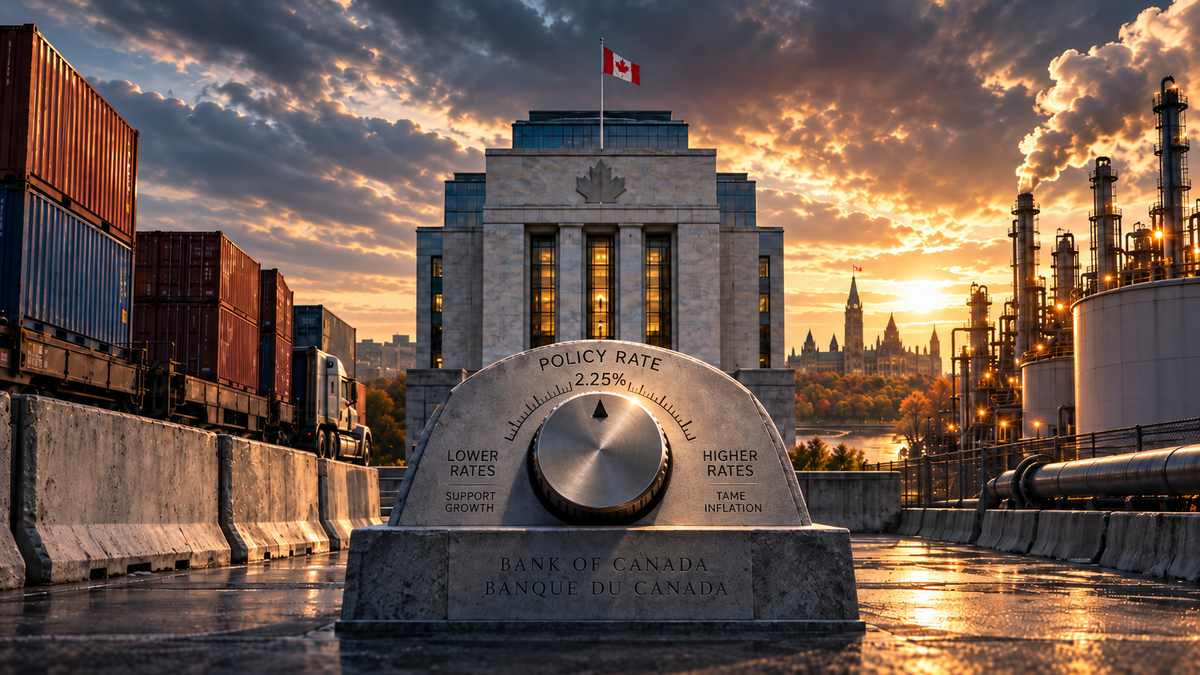
The Bank of Canada held its policy rate at 2.25 per cent this month. Now Governor Tiff Macklem says the latest U.S. tariffs, if they remain in place, could roughly halve fourth-quarter growth while high energy and refining costs keep inflation elevated. The Bank cannot remove either shock. It still has to decide what interest rate the Canadian economy needs while they work through it.
The Bank of Canada left interest rates alone on September 2. Three weeks later, the reason looks more complicated than a simple decision to wait.
Governor Tiff Macklem told an audience in Halifax on September 21 that renewed Canada-U.S. trade uncertainty is threatening investment and growth just as high oil prices and refinery disruptions are keeping inflation elevated. If the latest U.S. tariffs remain in place, the Bank estimates fourth-quarter growth could be roughly cut in half, to below 1 per cent. That would normally make a central bank worry about weakness. But gasoline and diesel remain expensive, Canadian counter-tariffs are adding costs for some businesses, and headline inflation is sitting at 3 per cent.
The Bank’s problem is that these forces do not line up neatly. Tariffs can weaken demand while raising some costs. Energy can lift prices while leaving households with less money to spend elsewhere. Economic slack can absorb part of those pressures.
The hard part is deciding whether these shocks fade, spread or change behaviour — and setting the policy rate before the answer is fully visible.
Tariffs reach beyond the border
The latest U.S. tariffs directly affect products representing about 5 per cent of Canadian goods exports to the United States. The Bank does not expect that exposure alone to produce a large economy-wide hit, although the consequences can be severe for businesses, workers and communities caught inside targeted sectors.
The harder problem is uncertainty. Canadian firms spent much of the past year changing suppliers, reducing tariff exposure and looking for customers outside the United States. Those adjustments were beginning to show up in the numbers: Macklem said non-energy exports rose 14½ per cent in the second quarter, reaching their highest level since early 2025. Another round of unpredictable trade measures can interrupt that adjustment even when a company is not directly tariffed.
A manufacturer considering a new production line has to think about where its inputs will come from, whether an American customer will still buy from it and what cross-border costs might look like when the investment is finally operating. If the answers keep changing, waiting can become the rational choice. Enough companies waiting means weaker investment and hiring, which is why the Bank’s concern extends well beyond the dollar value of goods covered by tariffs.
Canada’s response adds another layer. Counter-tariffs that took effect September 8 apply to $27.6 billion of U.S. imports, with rates of 15, 25 or 50 per cent depending on the product. They are concentrated in sectors including steel and aluminum, dairy, appliances, agricultural equipment, pulp and paper, plastics and electronics.
The Bank expects the inflation effect to be modest because the counter-tariffs primarily target non-consumer goods that can be replaced with Canadian substitutes. That does not make the effect zero. Some businesses will still pay more for inputs or have to change suppliers, and how much of that cost they absorb — or eventually pass on — is part of the Bank’s calculation.
Energy changes the inflation arithmetic
The Middle East conflict creates a different problem. When the Bank published its July forecast, it expected the conflict to ease and supply disruptions to gradually normalize. Instead, important shipping routes remain disrupted and refinery capacity has been damaged.
Macklem offered a useful rule of thumb: under normal circumstances, a 10-per-cent increase in oil prices adds about 0.2 percentage points to CPI inflation. The current shock has been more complicated because crude oil is only part of the story. Damage to global refining capacity has pushed gasoline and diesel costs higher than the oil price alone would suggest; Macklem said recent gasoline prices have behaved more like crude was almost US$40 a barrel more expensive than it actually was. If oil stays near US$100 a barrel, the Bank expects inflation to edge higher in the coming months.
That helps explain why the latest inflation numbers can look contradictory. Statistics Canada reported CPI inflation of 3.0 per cent in August, unchanged from July, while inflation excluding gasoline was 2.4 per cent. The Bank’s preferred measures of core inflation were lower again: CPI-trim at 1.9 per cent and CPI-median at 2.0 per cent.
Three per cent puts headline inflation at the top of the Bank’s 1-to-3-per-cent inflation-control range, while the core measures remain much closer to the 2-per-cent target.
That distinction matters because the Bank does not need to treat every increase at the gas pump as proof that the whole economy is overheating. Monetary policy cannot produce crude oil, repair damaged refineries or reopen an international shipping route.
What matters is whether the shock stays concentrated. Higher fuel costs feed into transportation and distribution, and businesses must decide whether to absorb them, find savings elsewhere or pass them on. If price increases begin spreading broadly through goods and services — and start changing inflation expectations — an external energy shock becomes a more persistent domestic inflation problem. So far, the Bank says there has been limited evidence of that broader spillover. The longer fuel prices remain high, the more closely it has to watch.
The economy recovered. It is not overheating.
Canada entered this latest bout of uncertainty in better shape than it had been earlier in the year. Real GDP increased 0.8 per cent in the second quarter, led by exports, household spending and business capital investment. Expressed at the annualized pace used by the Bank, growth was about 3.3 per cent.
That rebound mattered when Governing Council met, but policymakers still judged the economy to be operating in excess supply — meaning it had room to grow without immediately generating excessive inflation pressure.
Labour data released two days after the rate decision reinforced the point. Employment fell by 42,000 in August, the employment rate slipped to 60.8 per cent and unemployment remained at 6.4 per cent. Average hourly wages were up 2.0 per cent from a year earlier.
Macklem said again on September 21 that, even with the recent rebound, the economy remains in excess supply.
Economic slack changes how higher costs move through the system. A company facing a tariff or a higher fuel bill may want to raise prices, but whether it can depends partly on its customers. In a soft market, businesses have less room to pass through every increase without losing sales. Weak demand can therefore restrain inflation even while individual costs are rising.
That is one reason the Bank cannot look at headline CPI alone and decide where rates should go.
What the Bank can actually do
The Bank’s main monetary-policy tool is its target for the overnight rate. By changing that target, it influences short-term interest rates and financial conditions throughout the economy, affecting mortgages, consumer borrowing, business investment, housing activity and overall spending.
It cannot change the tariff applied to a Canadian product at the U.S. border. A lower policy rate may make financing cheaper for a manufacturer, but it cannot restore lost market access. A higher rate can restrain demand if inflation becomes too broad, but it cannot increase refinery capacity overseas or lower the world price of crude.
Macklem made that boundary explicit both in his September 2 opening statement and again in Halifax: monetary policy cannot offset tariffs or influence global energy prices. Its job is to prevent those shocks from knocking Canadian inflation persistently away from target.
That is a narrower job than fixing the underlying problem. It is still a consequential one.
Persistence is the real question
The Bank already knows that higher fuel prices lift headline inflation and that tariffs hurt affected industries. The harder questions begin after the first-round impact.
Will businesses postpone investment for a few months or several years? Will expensive energy remain mostly visible at the gas pump, or spread through a wider range of prices? Will households and businesses continue to expect inflation to return toward 2 per cent?
Those answers matter because monetary policy works with a lag. By the time an interest-rate change has fully worked through the economy, the original shock may have faded — or become something more persistent. That helps explain why Governing Council did not pre-commit to either a cut or an increase in September. Weakening growth would reduce inflation pressure elsewhere; broader and more persistent price increases could require the opposite response.
The Bank is also changing part of the machinery it uses to make that judgment. Its October Monetary Policy Report will be the first to use a new forecasting model called Prima as the Bank’s primary model. Macklem said Prima was developed to help distinguish temporary inflation pressures from more persistent ones and improve the Bank’s ability to examine alternative economic scenarios.
That does not make the uncertainty disappear. It tells us what the Bank is trying to measure.
Its next scheduled policy-rate decision and Monetary Policy Report arrive on October 28.
Canada has to solve the part the Bank cannot
There is a limit to what monetary policy should be expected to accomplish. The Bank can influence demand and financial conditions; it cannot negotiate trade access, redesign supply chains or build the infrastructure Canadian exporters need to reach different markets.
Businesses and governments operate on that side of the problem. Macklem says Canadian firms are already reducing tariff exposure, changing sourcing strategies and expanding relationships with customers outside the United States. He also pointed to infrastructure, internal trade barriers, regulation and worker adjustment as areas where governments can influence how easily the economy adapts.
The Bank’s responsibility is different. It has to decide how much monetary restraint or support the economy needs while that adjustment happens, without reacting too aggressively to temporary price shocks or waiting too long if they become persistent.
That distinction matters for anyone hoping an interest-rate decision will somehow settle the larger trade dispute.
It will not.
The Bank of Canada cannot reopen a market or repair a refinery.
It still has to set monetary policy for the economy living with the consequences.