At Eleven, Light Falls on an Unknown Soldier’s Headstone
The Unknown Soldier rests at Ottawa’s National War Memorial. His original headstone tells another story at the Canadian War Museum, where remembrance is built into the architecture.
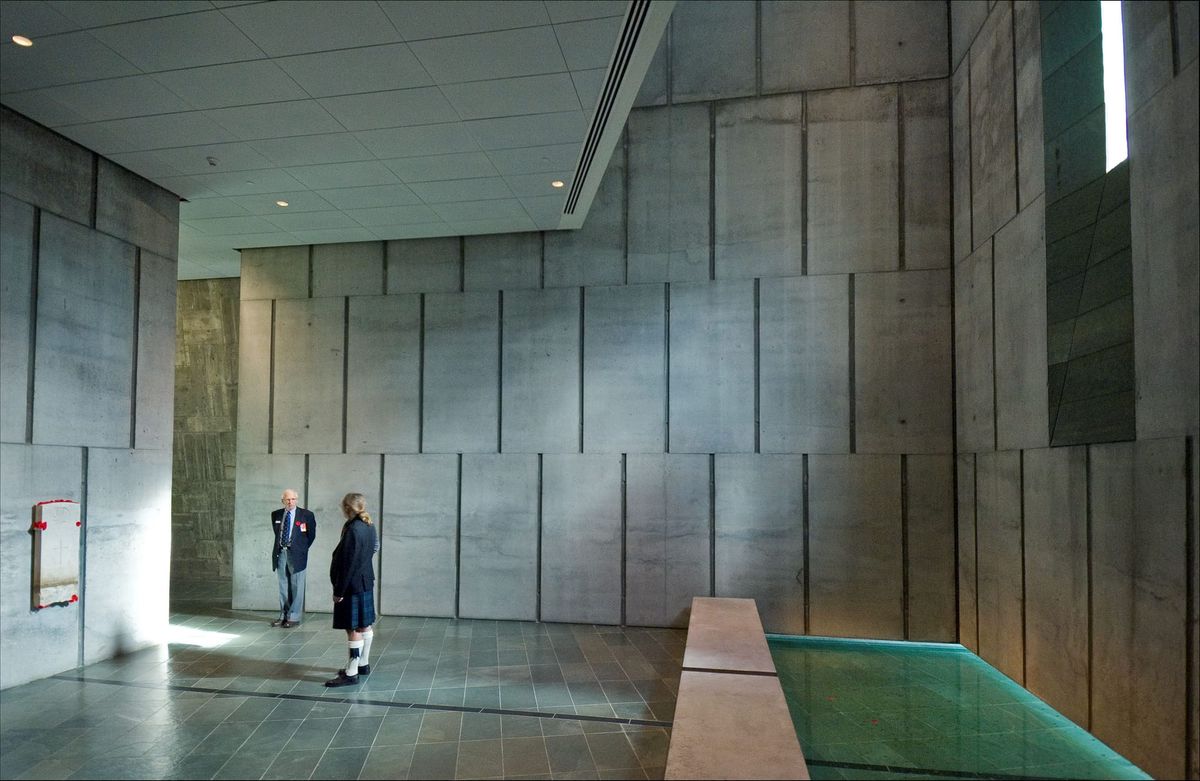

At the Canadian War Museum, a single window was positioned for a particular moment. At 11 a.m. on November 11, when the sun is shining, its light can frame the original headstone of Canada’s Unknown Soldier.
The soldier himself lies at the National War Memorial. His headstone travelled from France to a different place in Ottawa, where a room was built around it. Understanding how those two places are connected gives the annual moment in the museum its meaning.
The grave marker came home, too
In May 2000, Canada brought home the remains of an unidentified Canadian soldier from the First World War. The Commonwealth War Graves Commission had selected him from Cabaret-Rouge British Cemetery, near Vimy Ridge. His remains lay in state in Parliament’s Hall of Honour before he was buried in front of the National War Memorial on May 28.
The burial gave Canada a national place to honour a person whose name could not be recovered. Soil from Canada’s provinces and territories, along with soil from France, was placed on the coffin. A soldier who had lain overseas was brought into the centre of the country’s public remembrance.
His original grave marker was also preserved. The sandstone headstone, made between 1920 and 1925, was donated to the Canadian War Museum. It had marked an actual burial place in France. Its inscription offered no name: “A Soldier of the Great War — A Canadian Regiment — Known Unto God.”
Bringing the stone home kept that part of his history alongside the new memorial in Ottawa.
A room built around remembrance
Memorial Hall is deliberately spare. Its concrete walls have a pattern of offset rectangles recalling rows of military grave markers. There is a simple bench and a reflecting pool. The headstone is the room’s only artifact.
That arrangement gives visitors little to compete for their attention. A stone that once stood among other graves has a room to itself. The museum preserves its history while leaving people space to consider what it represents.
The headstone was given its place in Memorial Hall when the museum opened at its present location in 2005. The annual alignment with the sun makes the building itself part of the act of remembrance. Visitors can return to the same place at the same hour, while the people taking part change from one year to the next.
Another generation takes part
The Royal Canadian Legion helped initiate the effort to bring the Unknown Soldier home. This year, the organization marks 100 years since its incorporation on July 17, 1926. Its origins lie in the Unity Conference of 1925; incorporation is the anniversary the Legion recognizes.
November 11, 2026, also falls 95 years after Canada’s first official Remembrance Day in 1931. Armistice Day observances had begun in 1919. The commemorations we inherit have their own history of people deciding how to remember together.
Keeping those traditions meaningful also involves younger Canadians.
There is a contemporary example in this year’s Veterans’ Week poster. Veterans Affairs Canada selected artwork by Vancouver’s Chaelyn Han, created through the Legion’s National Youth Remembrance Contests. Her work uses bright colours and stylized figures, bringing a young artist’s expression to an established national observance.
The headstone and the poster do different work. One preserves a physical connection to a life lost in war. The other shows a young Canadian choosing how to express remembrance now. Keeping the tradition alive requires both care for what has been entrusted to us and opportunities for another generation to take part.
A place in the day
Anyone planning to visit Memorial Hall on November 11 should check the museum’s current visitation arrangements. The museum lists a 10:40 a.m. start, with a limited number of free tickets available from 9 a.m. and no advance reservations. The illumination will also be shown on a screen in the museum lobby. Arrangements are subject to change.
There are ways to give remembrance attention wherever the day finds you. Attend a local ceremony, pause at eleven or spend time learning about someone commemorated in the Canadian Virtual War Memorial. A name on a community monument can be the beginning of that search. Where a family member or veteran wishes to share a story, make time to listen.
For a name that history could not recover, Canada has made a permanent place. We can make room in the day.