Tariffs Were a Toll Booth. Import Bans Are a Locked Gate.
Tariffs make market access more expensive. Import bans can shut the gate. Canada’s answer is more routes, more resilience — and more choices at home.
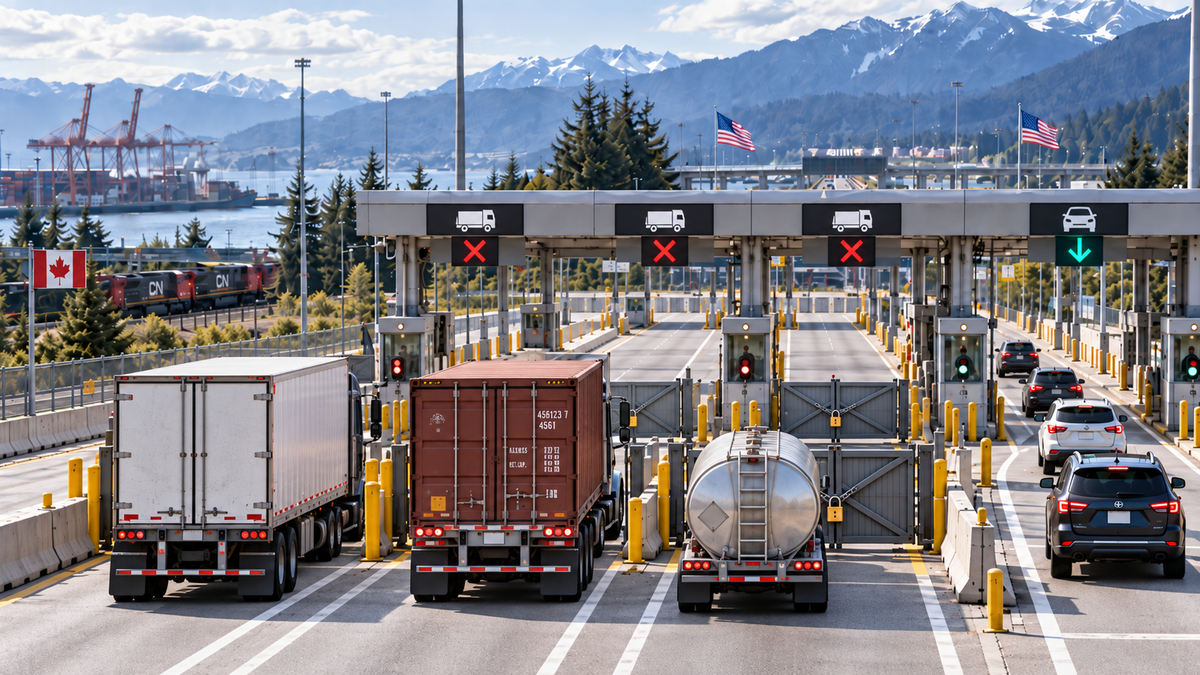
Washington’s latest retaliation targets only part of Canada’s trade with the United States. That isn’t the part Canada should ignore. The bigger warning is that market access can move from expensive to unavailable with another turn of the policy dial. Canadians, meanwhile, still control one part of the equation ourselves: what we choose to buy.
Canada just got a lesson in the difference between an expensive door and a locked one. A tariff says your case of beer, motorcycle or bag of whey protein can still cross the border if somebody is willing to swallow the extra cost. An import ban says don’t bother loading the truck.
That isn’t just a metaphor. On Sept. 8, U.S. President Donald Trump signed five proclamations under Section 338 of the Tariff Act of 1930 that both exclude selected Canadian products from the U.S. market and modify earlier tariff lists. The bans take effect Sept. 29; additions and removals from the tariff lists take effect Sept. 15. The banned lists cover most Canadian alcoholic beverages, several dairy-related products including whey, and motorcycles with engines larger than 800 cc.
One Canadian manufacturer has already put a name on the impact. BRP says its Can-Am Spyder and Canyon three-wheelers, built in Valcourt, Que., will be barred from the U.S. market beginning Sept. 29. The company expects the immediate financial hit to be limited because most production and shipments for the current season are already complete.
Section 338 itself helps explain why this escalation matters. The statute gives a president authority, under specified circumstances, to impose additional duties of up to 50 per cent in response to discrimination against U.S. commerce. If that discrimination is maintained or increased after an earlier proclamation, the law also provides authority to exclude products from importation when the president deems that consistent with U.S. interests and the public interest. In other words, the law contains its own path from toll booth to locked gate.
The bans arrived the same day Canada’s latest counter-tariffs took effect. Ottawa says those measures cover C$27.6 billion in U.S. imports, with rates of 15, 25 and 50 per cent across products concentrated in sectors including steel and aluminum, dairy, appliances, agricultural equipment, pulp and paper, plastics and electronics.
Washington describes its new measures as retaliation for Canada’s retaliation. Canada says its tariffs answer earlier U.S. measures. At this rate, somebody may eventually need a whiteboard. The jokes get easier. The underlying problem does not.
This is not a blanket ban
The United States has not closed its market to Canadian goods, and pretending otherwise would weaken the argument. These proclamations identify specific product lines, not everything Canada sells south of the border.
But the scale of the broader relationship is exactly why the escalation matters. In 2025, 71.7 per cent of Canada’s merchandise exports went to the United States, down from 75.9 per cent the year before. Reuters reports that the share has fallen further to almost 68 per cent so far this year, while roughly 80 per cent of Canadian exports to the U.S. have continued to move duty-free through USMCA exemptions. The new Section 338 tariffs are different: the White House explicitly says they apply to covered goods even when those goods otherwise qualify under USMCA.
That gives Canada some resilience, but it also shows the concentration risk. The United States remains our largest customer by a very wide margin. Nobody serious should be pretending Europe or Asia can simply show up Tuesday morning with a wheelbarrow and buy everything America currently takes.
The immediate damage from these particular bans may therefore be manageable. The precedent deserves considerably more attention. For products that move from a tariff list to an exclusion list, market access is no longer a question of whether the price of crossing the border is tolerable. It is a question of whether the product is allowed through at all. That changes the risk calculation.
Washington also went after the government shopping cart
The import bans were accompanied by another move that could ultimately prove more consequential. Trump directed the U.S. General Services Administration and the U.S. Trade Representative to remove Canadian-origin products from the GSA Multiple Award Schedules unless Canada restores what he calls “full and fair reciprocity” for American companies and farmers. The MAS program is one of Washington’s main purchasing vehicles for commercial goods and services.
USTR described the direction as removing US$50 billion worth of Canadian-origin products from the schedules. The White House phrased it differently, saying the schedules themselves manage more than US$50 billion in federal procurement. GSA says the MAS program provides streamlined access to more than US$52 billion in products and services annually.
Those statements are not interchangeable. As of Sept. 10, no public GSA implementation document reviewed by Nasty Canuck establishes that Canadian suppliers actually account for anything close to US$50 billion of MAS business. Until GSA publishes the mechanics and Canadian exposure, US$50 billion should not be presented as the amount of Canadian business being kicked out.
Canada’s side of the procurement argument also deserves more than a slogan. Ottawa has tightened its federal purchasing rules. Its current strategic Buy Canadian policy applies to qualifying competitive procurements worth $5 million or more and gives eligible Canadian suppliers a 10-per-cent reduction to their financial bid for evaluation purposes. The policy also rewards Canadian content. But when an applicable international trade agreement covers the procurement, suppliers from the relevant trading partner remain eligible to compete.
Washington is not alone in questioning those preferences. At a WTO Government Procurement Committee meeting in June, the United States again raised concerns about Canadian federal procurement policies introduced in December 2025, and eight other parties to the WTO Government Procurement Agreement expressed similar concerns. Canada responded that it remained committed to engaging with its GPA partners. That establishes a genuine international policy dispute; it does not, by itself, establish that Canada is violating its obligations.
There is another wrinkle that tends to disappear from political shorthand: Canada-U.S. government procurement access is not governed bilaterally by CUSMA. Canada and the United States rely primarily on their commitments under the WTO Government Procurement Agreement. Those commitments apply to covered procurements, entities and thresholds; they are not a promise that every government contract on either side of the border must be open without qualification.
So Washington has a real procurement dispute to raise. That is different from proving that Canada simply hung an “Americans need not apply” sign over the federal purchasing department. Sometimes reading the procurement rules is more useful than reading the social-media post about them.
Canada’s real problem is concentration
Trade diversification is often sold in Ottawa as though it were an inspirational slogan. In reality, it is insurance.
Canada should continue trying to repair and preserve the U.S. trading relationship. Geography is not going anywhere, nor are decades of integrated supply chains, rail lines, pipelines, factories, electricity connections, investment and businesses built around moving things across the border. A strategy based on economically separating Canada from the United States would be enormously expensive and, in many industries, fanciful.
But partnership and dependence are not the same thing.
If one customer buys most of what you sell, that customer has leverage. If one route carries most of your exports, disruption on that route becomes a national problem. And if access to that market can move from preferential trade, to tariffs, to production-location threats, to outright exclusion of selected products, Canada needs more credible alternatives whether relations with Washington improve next month or not.
That requires more than signing another trade agreement and congratulating ourselves. It means ports capable of moving more goods, pipelines connected to more customers and transportation infrastructure that can actually reach those ports. It means fewer barriers to selling between Canadian provinces, procurement policies that help domestic companies scale while respecting the trade obligations Canada expects others to honour, more manufacturing capacity, and more trade relationships where Canadian companies are actually selling something rather than merely attending a ministerial photo op. And, where it makes sense, it means buying more from each other.
The border belongs to governments. The wallet belongs to Canadians.
Governments control an enormous amount of what happens at a border. They can impose tariffs, negotiate trade agreements, restrict selected imports, rewrite procurement rules and change what products cost or whether they are available at all.
But for an ordinary voluntary purchase, neither Ottawa nor Washington gets to decide which product a Canadian chooses from the shelf. It doesn’t matter whether the American gate is wide open, charging a toll or locked for selected goods. Buy Canadian is still a choice.
No executive order in Washington can make somebody in Winnipeg prefer an American brand. No trade agreement requires a family in Halifax to choose a foreign product over a Canadian alternative. And no piece of legislation can manufacture customer loyalty that a company has not earned.
That does not mean Canadians should buy something merely because somebody slapped a maple leaf on the package. Buy Canadian should be a preference, not a participation trophy. Canadian companies still have to compete on price, quality, service and value. Sometimes the best option will come from the United States, Europe, Asia or somewhere else. Open markets give consumers choices too, and there is no virtue in pretending otherwise.
But when a competitive Canadian-made, Canadian-grown or Canadian-provided alternative exists, Canadians have agency that goes well beyond whatever governments happen to be doing at the border. Spending at home can support Canadian workers, suppliers, tax revenue and productive capacity — the very things Canada needs if it wants more room to manoeuvre when somebody else changes the rules.
One shopping cart will not reshape the Canadian economy. Millions of them can. Governments can spend years negotiating market access abroad; Canadians can strengthen the domestic market every Saturday morning.
The border may belong to governments. The wallet belongs to us.
Retaliation is leverage. Alternatives are power.
Canada’s counter-tariffs are meant to impose pressure. Canadian officials told Reuters the measures were designed to put both economic and political pressure on Washington. That may create negotiating leverage, but it also carries costs at home, which is why retaliation cannot be the whole strategy.
Canada-U.S. Trade Minister Dominic LeBlanc said after Washington’s latest move that Ottawa was assessing the measures and that he remained in contact with U.S. Trade Representative Jamieson Greer. He reiterated that Canada’s priority was protecting Canadian workers, farmers, families and businesses and said Ottawa remained willing to work toward a mutually beneficial relationship that respects Canadian sovereignty.
That is where the long game matters. Canada is in a trade dispute with an economy vastly larger than its own, and every escalation can hurt Canadian businesses and consumers too. The objective cannot simply be to find another American product to tax every time Washington finds another Canadian product to hit.
The more durable answer is to make Canadian choices less dependent on what happens in Washington. Government has a role: build infrastructure, lower internal trade barriers, open markets, defend Canadian access and use public procurement intelligently. Business has a role: invest, innovate and give Canadians products worth choosing. And when a competitive Canadian option exists, the rest of us get to decide where our money goes.
None of that replaces the U.S. market, nor should it. Some Canadian businesses will never find another customer as large, close or profitable as the United States. Pretending otherwise would be its own form of nonsense. But the lesson is getting harder to miss.
A tariff is a toll booth. An import ban is a locked gate.
Canada doesn’t need to stop using the road to America.
It needs to make damn sure it has more than one road out — and remember that we decide where plenty of the roads inside Canada lead.