Saab Has a Canadian Assembly Team. Where’s the Order?
Saab’s new deal with IMP sharpens Ottawa’s fighter choice. How much Canadian control, export work and long-term capability would come with it?
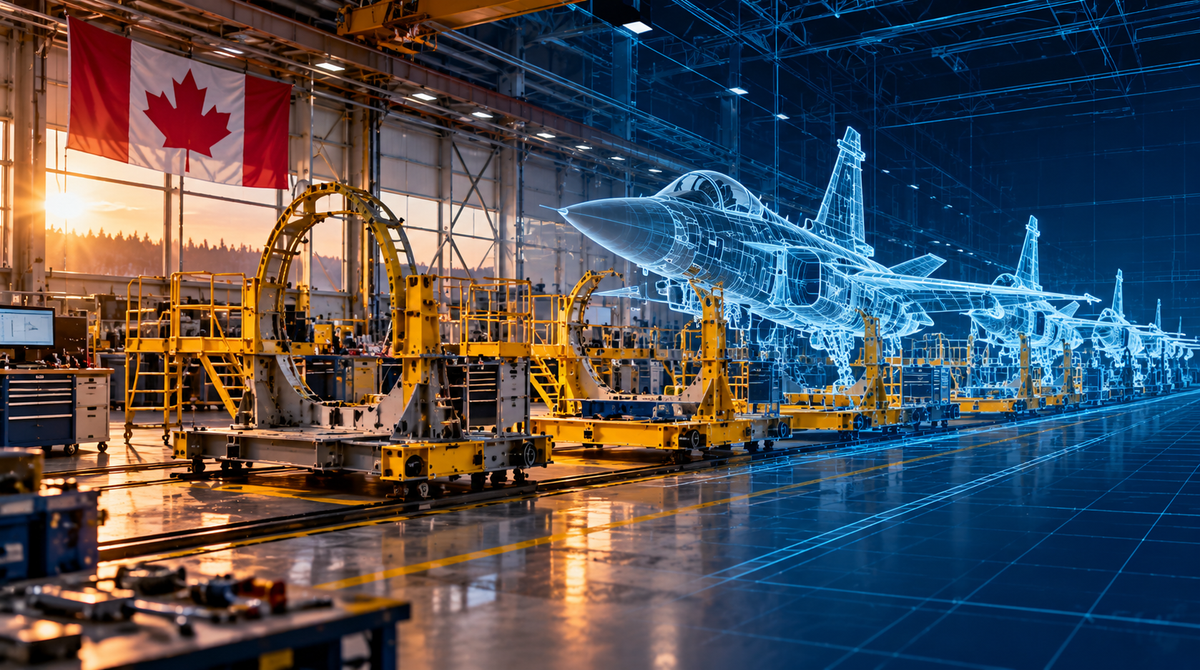
Saab has chosen IMP for Canadian Gripen final assembly—if Ottawa buys the jets. The factory, Canadian workshare and purchase decision remain unsettled.
An assembly line can produce a remarkable amount of optimism before it produces an aircraft. Saab has supplied the latest reason to ask what would turn a Canadian fighter proposal into an actual Canadian capability.
An agreement, with a substantial condition
On October 27, Sweden’s Saab named IMP Aerospace & Defence, Magellan Aerospace and CAE as its principal Canadian Gripen E partners. The centrepiece is a signed teaming agreement with IMP, which would establish a Canadian final-assembly line if Ottawa chooses the fighter. IMP’s proposed responsibilities also include electrical assembly production and in-service support.
Saab also signed a new memorandum of understanding with Magellan for aerostructures and composite assemblies. CAE’s agreement dates to July and covers proposed pilot and technician training, simulation, mission-systems engineering and sustainment.
These are meaningful industry arrangements. They are not a Canadian aircraft purchase. Saab’s announcement does not identify the assembly site, provide a construction budget or schedule, quantify firm Canadian jobs, or disclose a binding aircraft or export order. IMP sees potential to work on Gripens for international customers; potential is the operative word.
The F-35 is already more than a line on a spreadsheet
Canada announced plans to acquire 88 F-35s in January 2023, then ordered a review of that decision in March 2025. National Defence said in May 2026 that the review was continuing, taking account of operational requirements, NORAD and NATO commitments, industrial benefits and potential alternatives. Canada has committed to an initial 16 F-35 aircraft under the existing arrangement.
The program is no longer hypothetical. By October 22, the Royal Canadian Air Force had accepted its first two CF-35As at Luke Air Force Base in Arizona, where the initial Canadian aircraft are intended for pilot training. They have not arrived at a Canadian operational base.
Nor is the F-35 industrial footprint exclusively American. National Defence reported in May that more than C$5.2 billion in cumulative contracts had been awarded to over 110 Canadian companies across the program, while 37 companies held active F-35 contracts at that point. It identified Magellan itself among the Canadian firms holding active F-35 work. Those awards are not a guarantee of future jobs or contracts, but they are part of the existing economic baseline against which any alternative must be measured.
A mixed fleet could give Canada another supplier relationship. It could also require Canada to sustain two different fighter types, with consequences for training, logistics and cost. Ottawa needs to show the military and financial comparison, not simply count possible assembly jobs.
The difference between a Canadian line and Canadian control
There is precedent for Saab transferring real production work. On October 6, the first Gripen E produced in Brazil made its maiden flight after assembly by Embraer. That is a physical milestone in an existing national program. It demonstrates what a production partnership can eventually deliver, not what Canada has already secured or what it would cost here.
For a Canadian line, the questions begin at final assembly and continue into engineering authority. Which assemblies would actually be manufactured here? Could Canadian engineers modify and certify mission systems? Who would control technical data, software updates, deeper repairs and exports to other Gripen customers? Would guaranteed orders justify the investment in buildings and skilled people?
The distinction matters because Canada is already negotiating separately with Saab over the GlobalEye surveillance aircraft. That non-binding term sheet is not a Gripen purchase, and possible industrial work on one program should not be counted as a contract for the other. We covered the GlobalEye terms in September.
The American engine remains part of the equation
The Gripen E uses the GE Aerospace F414-GE-39E engine. On July 22, GE and Magellan signed a conditional memorandum for engine maintenance, repair and overhaul at Magellan’s Mississauga facility. GE would provide training and a licence for that Canadian sustainment operation if the fighter were selected.
That could keep valuable maintenance capability in Canada. It would not, on its own, make Canada the engine designer or settle future access to parts, technical permissions and export approvals. A Swedish aircraft with substantial Canadian work can still have an important American dependency. Neither pretending otherwise nor treating that dependency as an automatic veto would be sound analysis.
Show the bargain before celebrating the build
Saab and its partners have advanced the industrial pitch. Now Ottawa needs to establish the aircraft requirement and publish enough of the proposed deal for Canadians to judge it: what would be built here, who would pay for the facilities, which rights Canada would retain, how export work would be secured, and what the full fleet would cost to buy, operate and support. The F-35 commitments already underway belong in that calculation, too.
There may be a compelling Canadian industrial opportunity in the Gripen proposal. It deserves a serious evaluation, alongside the operational case and the existing program—not a reflexive dismissal or a premature victory lap.
A signed teaming agreement is a starting point. It is not yet a Canadian fighter assembly line.