Ottawa puts $50 million into Canadian farm tech. Now comes the hard part.
Ottawa says the new CAAIN funding should support at least 40 technology projects and draw $80 million in private investment. Canada has the research, the partners and plenty of prototypes. The bigger test is getting more of them onto working farms — and keeping more of the resulting value here.
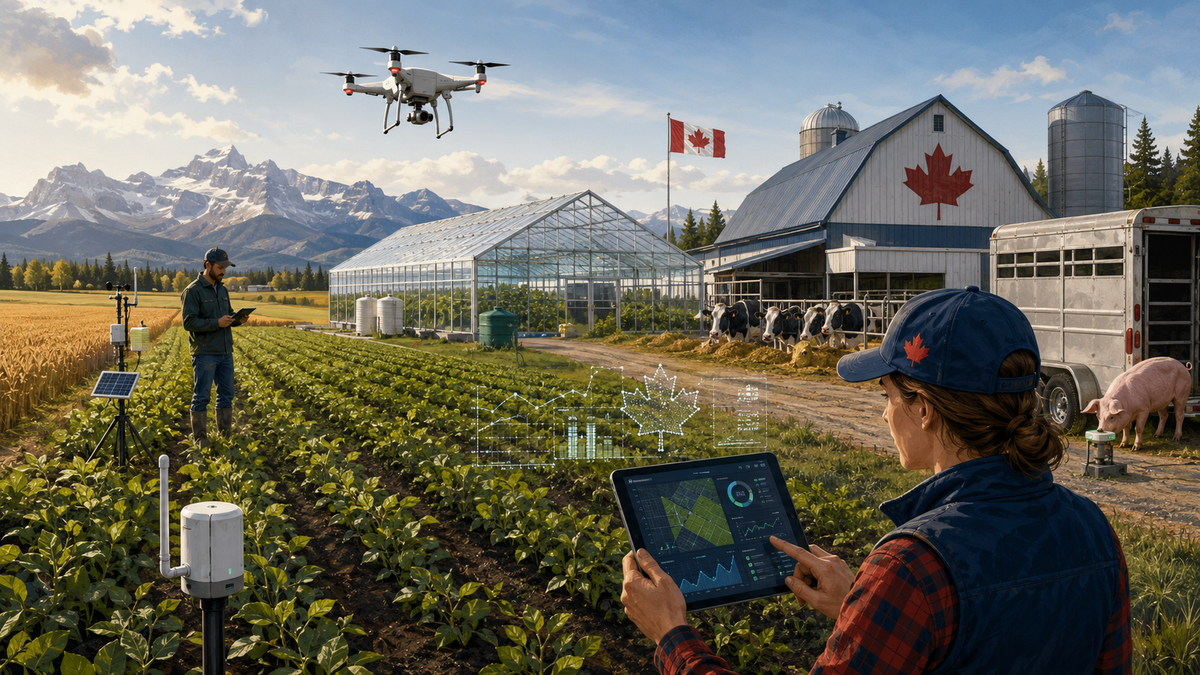
Ottawa is putting $50 million into Canadian agricultural automation and technology, with the money aimed not just at developing new tools but at getting more of them tested, commercialized and actually used. The investment, announced Aug. 26 in Calgary, is going to the Canadian Agri-Food Automation and Intelligence Network, or CAAIN, through the federal Strategic Response Fund.
The federal government says the funding is expected to support at least 40 new technology projects, attract $80 million in private-sector co-investment, create or maintain about 800 jobs, and expand CAAIN’s network to more than 3,000 members. It is also intended to support additional smart farms and commercial demonstration sites across Canada. Announcing the money is the easy part. The harder part is getting the technology out of the demonstration site and into somebody’s barn, greenhouse or field.
CAAIN is not starting from zero
This is not Ottawa putting $50 million into a brand-new network and hoping for the best. CAAIN says that over six years it has committed more than $42 million to 56 projects worth more than $133 million in total. The federal government separately credits the network with generating more than 100 intellectual-property assets and attracting more than $500 million in private follow-on investment. CAAIN’s 2024–25 annual report says 12 funded projects were at some stage of commercialization.
Those are encouraging numbers, but they also mean the next round of funding does not get to be judged entirely on promises. CAAIN now has something better than a pitch deck: a track record. The question is whether the next phase can move more technologies from funded project to commercial product to something a producer decides is worth paying for.
Canada has an adoption problem
Canada does not appear to be short of agricultural ideas. Getting those ideas into everyday use is another matter. Farm Credit Canada, working with Deloitte, reported in July that only 1.8% of Canadian agricultural businesses were using artificial intelligence as of the second quarter of 2025, compared with 12.2% of businesses in other industries.
FCC points to barriers including infrastructure, skills, investment costs and uncertainty about how to turn promising technology into something producers can confidently use. A prototype in a laboratory is impressive. A technology that a farmer can afford, trust, maintain and use through a Saskatchewan winter is considerably more useful. That is the gap CAAIN is supposed to help close.
Farmers do not need technology because it looks futuristic in a promotional video. They need tools that solve problems well enough to justify the cost, training, maintenance and disruption that come with adopting them.
What does farm tech actually look like?
Farm technology does not necessarily mean autonomous tractors roaming the Prairies while somebody supervises from an iPad. One current CAAIN-backed project is testing an AI-powered system that analyzes milk in real time at a commercial Canadian dairy. The technology is intended to help identify metabolic problems such as ketosis earlier while giving producers better information about milk production and herd performance. The project is also supposed to measure whether the technology delivers an actual return on investment using results from a working dairy.
That may sound less dramatic than a robot tractor, but it illustrates the point. Useful agricultural technology does not have to look like science fiction. It has to solve a real problem on a working farm and do it economically enough that somebody will keep using it after the demonstration is over. Other CAAIN-supported projects include AI-powered dairy logistics, smart traps that use cameras and AI to monitor orchard pests and a drought-monitoring system using satellite and drone imagery, climate records, soil-moisture data and field observations.
Occasionally, field testing discovers something no laboratory specification was likely to predict. In one completed CAAIN-backed livestock-transport project, developers went through multiple versions of a trailer sensor while making it rugged enough for real-world use. One early problem was particularly agricultural: CAAIN says the pigs ate one of the sensors. That is what commercial testing is for. The pigs, apparently, had notes.
Canada is not working alone
Ottawa’s National Food Security Strategy points to the Netherlands as an example of what a strong agricultural innovation system can look like. The Dutch have built deep connections among research, precision agriculture, controlled-environment production, processing and logistics. Canada is doing more than looking over the fence.
In 2024, Canada and the Netherlands strengthened a formal science, technology and innovation partnership, with food systems and agricultural technologies among its priority areas. That same June, the National Research Council took Canadian agritech companies to the Netherlands to meet Dutch companies and research organizations working in controlled-environment agriculture, precision farming, sensors, automation, robotics and AI. The mission included Wageningen University & Research and Food Valley.
Canada has even held its own in a Dutch greenhouse challenge. Agriculture and Agri-Food Canada scientists working from Harrow, Ontario, joined Microsoft Research’s Team Sonoma in Wageningen University & Research’s Autonomous Greenhouse Challenge. The team grew more than 55 kilograms of cucumbers per square metre, with a net profit 17% higher than local expert growers.
Apparently we can hold our own with the Dutch on cucumbers. The harder trick is turning experiments like that into technology Canadian producers use every day. A greenhouse at Wageningen and a grain operation in Saskatchewan are not exactly working under the same conditions, which is why field testing here matters.
Nor is the Netherlands Canada’s only partner. A 2026 Canada–Japan collaborative R&D competition is aimed specifically at AI and automation in agriculture, including crop monitoring, pest and disease detection, forecasting and technologies covering the farm-to-harvest chain. The Canada–UK science and innovation agreement names agricultural technology as a priority. Canada and South Korea have identified agri-tech as an area for deeper science and technology cooperation, while a 2026–27 Canada–Singapore R&D competition includes agritech and food security.
The point is not to collect international agreements like seed catalogues. It is to expose Canadian companies and researchers to good ideas, good partners and bigger markets — and bring useful knowledge back the other way. There is nothing wrong with borrowing a good idea from abroad, and there is certainly nothing wrong with selling a Canadian one back.
CAAIN’s current funding rules explicitly encourage international collaboration while requiring CAAIN funding itself to flow to Canadian entities. That does not guarantee the resulting intellectual property, companies or commercial value will remain in Canada, but it is a sensible starting point: learn from everybody, build here, sell everywhere and keep a meaningful share of the value in Canada.
What to watch
Ottawa connects the CAAIN investment to stronger domestic food production, more resilient supply chains and, ultimately, food affordability. Those are reasonable objectives, but $50 million for agricultural technology is not a $50-million grocery rebate. Any effect on food prices would be indirect: technologies first have to work, companies have to commercialize them, producers have to decide they are worth buying, and productivity or costs then have to improve enough for some of those gains to move through the food system.
That process can take years, and not every project will succeed. Nor should success be measured by whether all 40-plus projects become commercial winners. Agricultural innovation involves experimentation, and some technologies will turn out to be too expensive, too complicated, too fragile or simply unnecessary once they meet the realities of a working farm. That is useful information too. Finding out during a demonstration that something does not work is considerably cheaper than discovering it after thousands of producers have bought it.
The useful test comes after the funding announcement fades from view: how many technologies make it to market, how many Canadian producers actually adopt them, whether they lower costs, increase output, reduce waste or solve problems that matter on working farms, and whether Canadian companies can turn the successes into durable businesses with customers beyond the original demonstration site.
Canada has the researchers, producers willing to test new ideas, international partners and companies trying to commercialize the results. Now CAAIN has another $50 million to work with. Canada does not need more clever farm-tech demos. It needs technology that earns its keep in the field.