Critical Minerals Aren’t Strategic Until the Mine Gets Financed
Generation Mining has assembled roughly $1.3 billion in financing for Ontario’s Marathon project. Now the real test is turning strategic minerals into an operating mine.
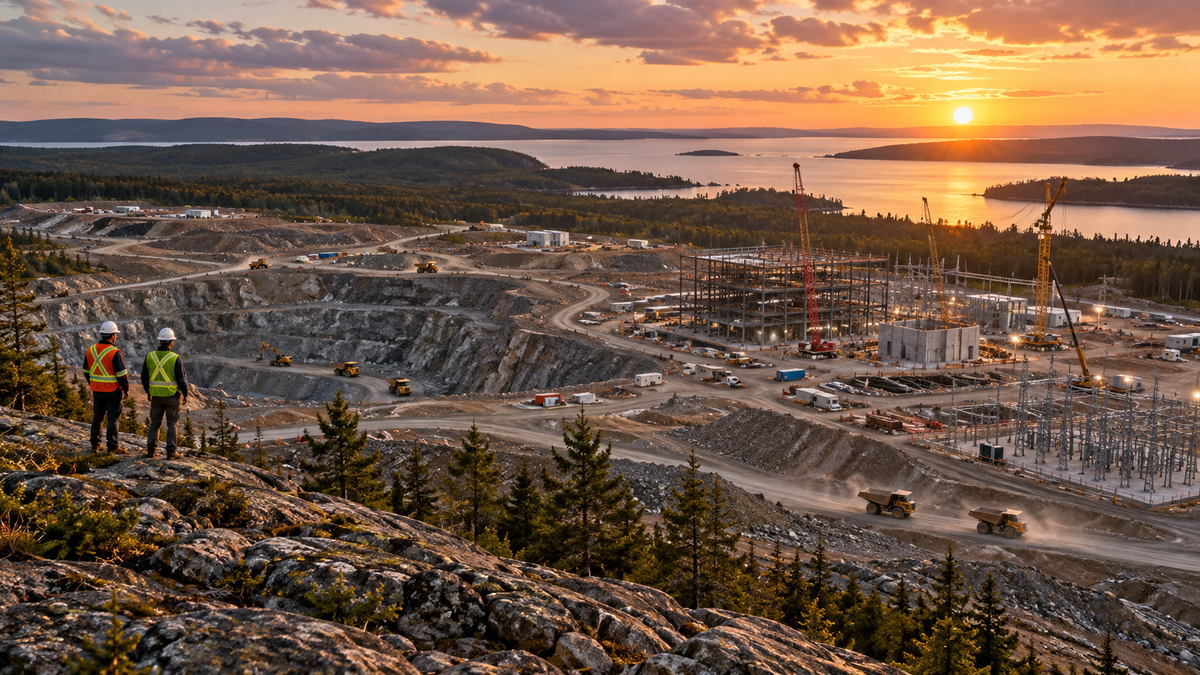
Generation Mining says it has assembled roughly $1.3 billion in construction financing for the Marathon copper-palladium project in Northwestern Ontario. That is a major milestone. It is not the same thing as a finished mine.
Canada talks a lot about critical minerals. The lists are long, the strategies are ambitious, and the maps are usually covered in colourful dots showing where the country has copper, nickel, lithium, graphite, uranium, rare earths and other materials governments increasingly describe as strategic.
A deposit on a map is still only potential. Strategic value starts to become real after a project gets through the permits, engineering, financing, construction, processing and customer agreements needed to turn rock in the ground into material somebody can actually buy.
That is what makes the latest development at Generation Mining’s Marathon copper-palladium project worth watching.
On Sept. 14, Generation Mining said it had secured the final $340 million needed to complete what it calls a fully financed construction package of roughly $1.3 billion for the project near Marathon, on the north shore of Lake Superior. The financing includes major commitments from the Canada Growth Fund, the Canada Infrastructure Bank, private investors, lenders, Wheaton Precious Metals and Glencore. Generation Mining says early works could begin in the fourth quarter of 2026.
That puts Marathon much closer to the point where Canada can stop pointing at a critical-minerals project on a map and start watching one get built. There are still some important boxes to check first.
A financing package is not a pile of cash
The headline number is easy to misunderstand. Generation Mining has not simply received a $1.3-billion cheque.
The construction package is a financing stack assembled from different sources with different terms, conditions and purposes. The latest $340-million component includes a $200-million bought-deal equity financing, a $40-million private placement by Canada Growth Fund, and $100 million in subordinated convertible notes, split evenly between Canada Growth Fund and the Canada Infrastructure Bank.
Canada Growth Fund says its total commitment is approximately $140 million: about $90 million in common shares and $50 million through a convertible note. Its stated role is to anchor the equity raise and help unlock the other financing needed to advance the project.
That sits on top of previously arranged financing including a roughly US$310-million senior secured project-finance facility from Export Development Canada, ING Capital and Société Générale; a $200-million CIB subordinated debt facility; an undrawn $200-million precious-metals streaming agreement with Wheaton Precious Metals; and equipment-leasing facilities.
The CIB facility itself includes $110 million for development and construction costs plus a $90-million standby facility for potential cost overruns.
This is what mine financing actually looks like. There is no single vault full of money waiting to be opened. Risk and funding are spread across equity, senior debt, subordinated debt, streaming, equipment finance and contingency facilities.
It is also why “fully financed” needs an asterisk.
Generation Mining says the package has been assembled, but several pieces still have to close. The $200-million bought deal is expected to close around Sept. 21 and remains subject to regulatory approval. The convertible-note financing requires shareholder and TSX approvals, with a special shareholder meeting expected in the fourth quarter. Definitive documentation, intercreditor agreements and customary project-finance conditions also remain outstanding.
The company’s board is expected to make its final investment decision after those financings are completed. So the money has been arranged; it has not all crossed the finish line.
Why $1.3 billion for a mine with a $992-million capital estimate?
Generation Mining’s 2025 feasibility study estimated initial capital of $992 million. That does not conflict with a financing package of roughly $1.3 billion.
The financing package is broader than the base initial-capital estimate. Generation Mining says it also incorporates contingency and cost-overrun capacity, surety bonds and letters of credit, along with other financing needed to support construction and project obligations.
That extra capacity matters because a financing plan designed only for the exact base-case construction estimate would leave little room for the sort of surprises large industrial projects have a habit of producing.
The feasibility study projects a mine life of roughly 13 years. Those forecasts remain forecasts, not guarantees. Mines have a long history of finding creative ways to cost more and take longer than expected.
This project has already cleared a lot of the harder gates
Marathon is further along than many projects that appear on Canada’s critical-minerals maps.
The federal and Ontario environmental assessment process was completed in 2022, with both governments approving the project subject to conditions. Ontario’s project record describes the joint federal-provincial environmental review.
Generation Mining received what it described as the final key construction permit in May 2025. Engineering and procurement have also moved beyond the conceptual stage. Ausenco was appointed as engineering, procurement and construction-management partner in March, and by August the company said bid pricing covering roughly 30 per cent of estimated project capital had come in, in aggregate, at or below the corresponding feasibility-study allowances.
The packages already being advanced include grinding mills, the high-voltage substation, primary crusher and process-plant equipment.
Marathon is no longer a project that exists mainly in a presentation deck.
The minerals are critical. The processing matters too.
Copper and platinum-group metals are both on Canada’s critical-minerals list.
The feasibility study projects average annual payable production of about 42 million pounds of copper, 168,000 ounces of palladium and 38,000 ounces of platinum, along with smaller amounts of gold and silver.
What happens after those materials leave the mine may be just as important as getting them out of the ground.
Generation Mining and Glencore have agreed to an offtake arrangement under which Glencore would buy Marathon’s polymetallic copper concentrate. Generation Mining says the concentrate will support processing at Glencore’s Horne smelter in Rouyn-Noranda, Quebec, and its CCR refinery, keeping a meaningful part of the downstream processing chain in Canada.
Under the announced terms, Glencore would take all concentrate production during the first two calendar years after commercial production begins and again from year 13 onward. During the intervening years, it would receive about half of annual production, leaving room for other offtake commitments.
Digging strategic minerals out of Canadian ground is useful. Extracting them here and then shipping every tonne elsewhere for processing captures less of the value.
A project that combines Canadian extraction with Canadian smelting, refining, engineering, construction and operating jobs comes much closer to the supply-chain strategy governments say they want.
There is a local scoreboard too
The project is expected to create more than 800 construction jobs and more than 400 direct permanent positions once operating, according to Generation Mining and the federal government.
There is also an Indigenous participation story that deserves more than a footnote.
The project lies within lands Biigtigong Nishnaabeg has described as its exclusive unceded ancestral lands. The First Nation and Generation Mining reached a Community Benefits Agreement that was ratified by community members in November 2022. The agreement includes commitments involving environmental management, employment, training and education, business opportunities, social and cultural support and financial participation.
In February, Biigtigong Nishnaabeg also made a $750,000 strategic investment in Generation Mining.
None of that eliminates the need to judge the project’s environmental performance or whether the promised benefits actually materialize. It does mean the local scoreboard should include more than tonnes of ore and ounces of palladium: jobs, contracts, training, Indigenous participation, environmental compliance and local economic activity all belong on it.
Canada’s financing tools are being tested on a real project
Marathon is also a useful test of Canada’s newer industrial-finance machinery.
The Canada Growth Fund is a $15-billion independent investment fund operating at arm’s length from the federal government, with a mandate to use investment capital to unlock private-sector investment in Canadian businesses and projects.
The Canada Infrastructure Bank’s critical-minerals program is aimed at financing projects and enabling infrastructure that can help move critical-mineral developments from resource potential toward commercial reality.
Neither institution is financing Marathon on its own. Underwriters have agreed to purchase the shares in the $200-million bought deal. EDC, ING and Société Générale have provided credit approvals for the senior project-finance facility, subject to final documentation and other conditions. Wheaton has an existing precious-metals streaming agreement. Glencore is participating in the equity financing and has agreed to offtake terms.
That mix is closer to the theory behind strategic public capital: government-backed institutions take defined positions that help a private project assemble the rest of the financing it needs rather than attempting to fund the entire mine themselves.
Whether that theory works here will be measurable.
The financings still have to close. The board still has to make its final investment decision. Marathon then has to hold its construction budget, stay reasonably close to schedule and eventually produce metals economically.
If it does, the project becomes a useful case study in moving Canadian critical minerals from policy priority to production. If it does not, the financing structure will still be worth studying — for very different reasons.
Now comes the part that matters
Generation Mining says early works could begin in the fourth quarter. That is the next meaningful checkpoint.
After that comes the work a press release cannot do: site preparation, concrete, equipment installation, power, workforce, commissioning and eventually production.
Canada has spent years identifying the minerals it considers strategically important. Marathon is approaching the point where the question changes.
The copper and palladium are in the ground. The permits are largely in place. Engineering is underway. The financing has been assembled.
Now Canada gets to find out whether all of that can become a mine.