Canada’s LNG Route to Asia Is About to Get Much Bigger
LNG Canada’s Phase 2 doubles more than terminal capacity. Coastal GasLink is expanding with it, creating a much larger Pacific export corridor.
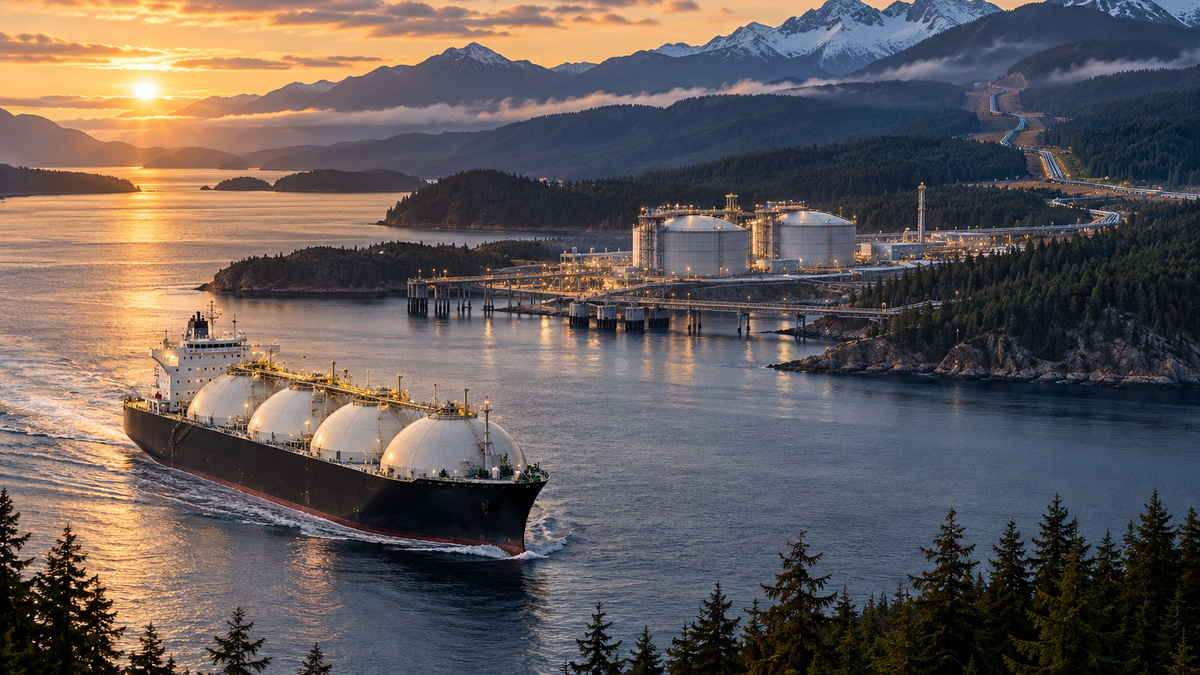
LNG Canada’s Phase 2 will double capacity at Kitimat and trigger a near-doubling of Coastal GasLink. The expansion is as much about the route to market as it is about the terminal itself.
Canada’s first large-scale LNG export terminal is moving from two processing trains to four.
The partners behind LNG Canada have made a final investment decision on Phase 2, adding two more liquefaction trains at Kitimat, B.C. Total production capacity is expected to rise from 14 million tonnes a year to 28 million tonnes, with commercial operations targeted for the early 2030s. The expansion also includes another LNG storage tank, condensate tank, loading berth and supporting systems.
Ottawa’s Major Projects Office has estimated Phase 2 could attract about $33 billion in private-sector capital.
But the terminal is only half the system.
On the same day, TC Energy confirmed that Coastal GasLink Phase 2 will proceed. The existing 670-kilometre pipeline carries about 2.1 billion cubic feet of natural gas a day from northeastern British Columbia to Kitimat. The expansion will nearly double that capacity by adding five compressor stations and upgrading facilities along the existing route rather than building another full-length pipeline.
Construction is expected to begin in early 2027, with the expanded pipeline targeted for service in the early 2030s.
Put together, Phase 2 is bigger than two new LNG trains. Canada is scaling an export corridor that already exists.
A second route for Canadian gas
For decades, the United States has been the overwhelmingly dominant market for Canadian natural gas exports.
That began to change when LNG Canada began exporting from Kitimat in June 2025. In 2025, Canada exported about 8.6 billion cubic feet a day of natural gas by pipeline, excluding LNG Canada, and nearly all of it went to the United States. On a full-year average basis, LNG Canada added another 0.295 billion cubic feet a day of LNG exports, all of it bound for East Asia.
The Canada Energy Regulator describes LNG Canada as Canada’s first large-scale LNG export terminal. Phase 2 does not replace Canada’s U.S. energy relationship. It increases the amount of Canadian gas that can reach overseas customers without first moving through the American market.
The ownership structure is multinational: Shell owns 40 per cent, PETRONAS 25 per cent, PetroChina 15 per cent, Mitsubishi 15 per cent and Korea Gas Corporation five per cent. Under the project’s equity-lifting model, each partner is responsible for its share of LNG production and for bringing its share of gas supply.
So this is Canadian infrastructure operating inside a global energy network, not a Canadian-only project.
An Indigenous equity option inside the expansion
Phase 2 also creates the possibility of a significant Indigenous ownership position.
In July, LNG Canada announced an equity option with MNT Investments LP, representing the economic development organizations of the Gitga’at, Gitxaała, Haisla, Kitselas and Kitsumkalum First Nations.
The agreement gives MNT the option to invest up to $1 billion for majority ownership of a special-purpose entity that would purchase the new LNG storage tank planned for Phase 2. The tank would then be leased back to LNG Canada for the operational life of the project.
That is more than a procurement or benefits agreement. If the option is exercised and the transaction completed, the participating Nations would own a major piece of the project’s infrastructure.
For now, however, it remains an option. Phase 2’s final investment decision clears one of the conditions needed for it to move forward.
The market case is large — and uncertain
The companies behind LNG Canada are making a long-term bet on global demand.
Shell expects LNG demand to rise substantially through the 2040s and says Kitimat is well positioned to supply Asian markets. But the project will also enter a market with a great deal of new supply.
The International Energy Agency’s Global LNG Capacity Tracker estimated in June that roughly 345 billion cubic metres a year of new LNG export capacity could come online globally between 2025 and 2030 from projects that had already reached final investment decision and were under construction at the start of 2025. The IEA says no comparable period in LNG market history has added as much export capacity.
Its 2026 gas-market update also shows why the outlook is not a simple surplus-or-shortage story. New supply is growing, while geopolitical disruptions in the Middle East have delayed some of the expected easing in global LNG markets.
For Phase 2, the opportunity is real, but so is the competition. Its economics will depend on construction costs, operating performance, global gas prices and how much demand is available when the new trains come online in the early 2030s.
Lower intensity does not mean zero emissions
Climate policy is another part of the project’s arithmetic.
Federal and British Columbia materials have described Phase 2 as a comparatively low-emissions-intensity LNG project. In May, the two governments said its emissions intensity was projected to be materially below global LNG benchmarks.
Lower intensity is not the same thing as low absolute emissions.
The Pembina Institute, which opposes the expansion, estimated in 2025 that Phase 2 could add about 2.1 million tonnes of annual emissions from the terminal itself by 2030, plus roughly 4.7 million tonnes associated with increased upstream gas production. Those are advocacy-group estimates rather than final operating results, but they show why a larger project can improve emissions intensity and still add substantially to total emissions.
That tension will follow the project through construction and into operation.
The hard part is now execution
Phase 2 has one advantage the original project did not: much of the underlying system is already there.
The Kitimat site was designed from the outset to accommodate four trains. Coastal GasLink is operating. LNG cargoes are already leaving the coast for Asia. The pipeline can increase throughput through added compression and facility upgrades rather than another 670 kilometres of new pipe.
That does not remove construction, cost, environmental or market risk. It changes the nature of the build.
Canada is no longer trying to create its first large-scale Pacific LNG export route from scratch. It is trying to scale one that is already operating.
The test now is whether LNG Canada and Coastal GasLink can deliver the expansion on schedule and at competitive cost, while the Indigenous equity option and the project’s emissions commitments move from plans on paper to outcomes on the ground.
The terminal may be the headline.
The route — and whether it works at twice the scale — is the story.