Keep Calm and Carney On
The Liberals had a very good night. But this isn't about painting Canada red. It's about something bigger: Canadians can support a prime minister who stands up for Canada without joining his fan club.
Three by-elections, three Liberal wins. But the more interesting question is whether Canadians are rewarding a kind of leadership in a trade fight that belongs to the country, not one party.
Three ridings. Three Liberal wins.
If you're a Liberal, Tuesday morning's coffee probably tasted a little better. If you're a Conservative, maybe it needed another spoonful of sugar.
But let's not get carried away. By-elections are not general elections. Local candidates matter. Turnout matters. And three ridings in three very different parts of the country do not amount to a national referendum on Mark Carney.
Still, three for three is three for three.
Preliminary results show the Liberals comfortably held Beaches–East York in Toronto and North Vancouver–Capilano in British Columbia. The more interesting result came in Quebec, where Daniel Gobeil won Chicoutimi–Le Fjord with 51.3 per cent of the vote. The Bloc Québécois finished second with just under 33 per cent, while the Conservatives — who had held the riding since 2018 — fell to 12.5 per cent. The sweep brings Carney's Liberals to 173 seats in the 343-seat House of Commons.
That's a good night by any reasonable political measure.
Carney called the sweep a “clear message” of support for his government's direction, including its position in the trade fight with the United States. Maybe. That's the prime minister's interpretation, and politicians have been known to find mandates in places where voters merely left them some votes. By-elections do not come with footnotes explaining why each person marked a ballot.
The results are interesting without pretending they prove more than they do.
This isn't really about the Liberals
By breakfast Tuesday, everyone had an explanation. Liberals called the results validation. Conservatives pointed to turnout, candidates and the peculiarities of by-elections. Strategists disappeared into spreadsheets while television panels began explaining what Canadians apparently meant by votes they cast for all sorts of different reasons.
That's politics. What interests us more is what's happening underneath the usual red-versus-blue machinery.
Canada is in the middle of a serious confrontation with its largest trading partner. After months of negotiations, Ottawa suspended talks on August 21 rather than accept terms it considered unacceptable to Canadian workers, businesses, strategic industries and sovereignty. The United States subsequently imposed new 50 per cent tariffs on C$27.6 billion in Canadian goods. Canada has announced dollar-for-dollar counter-tariffs on C$27.6 billion in U.S. imports, with rates of 15, 25 or 50 per cent depending on the product, scheduled to take effect September 8.
Those decisions have consequences for jobs, investment, prices, supply chains and entire communities. This isn't a hockey game. Nobody gets two points for winning the press conference.
Carney said this week that some of the American terms went beyond any single trade dispute and could have left important Canadian industries operating as subsidiaries of their U.S. counterparts or gradually disappearing from Canada. Whether every Canadian would have drawn the line in exactly the same place is debatable. The broader principle is less complicated: being the smaller economy does not obligate Canada to accept whatever deal the larger economy puts on the table.
Sometimes a bad deal is still a bad deal simply because the other side is bigger.
You can support the prime minister without joining his fan club
You can disagree with Mark Carney. You can oppose Liberal policies and have absolutely no intention of voting Liberal. You can be Conservative, NDP, Bloc, Green, independent or politically homeless and still want the Prime Minister of Canada to negotiate from a position of Canadian strength.
Patriotism is not partisanship.
There is evidence Canadians are already making that distinction. An Angus Reid Institute survey released after the trade talks collapsed found 76 per cent thought Canada was right to walk away rather than accept a bad deal. More interestingly, 53 per cent of people who voted Conservative in the 2025 federal election agreed.
That doesn't mean 76 per cent of Canadians suddenly became Liberals. It means people can support a decision without adopting the politician who made it.
When a prime minister represents Canada internationally, he isn't representing only the people who voted for his party. He's representing the country, including millions of Canadians who would quite happily vote him out at the next opportunity.
That creates an obligation for the prime minister. It should also leave the rest of us enough room to say, occasionally, that somebody we didn't vote for handled something well.
Giving credit isn't surrendering your political judgment. It's using it.
Calm is not the same thing as weak
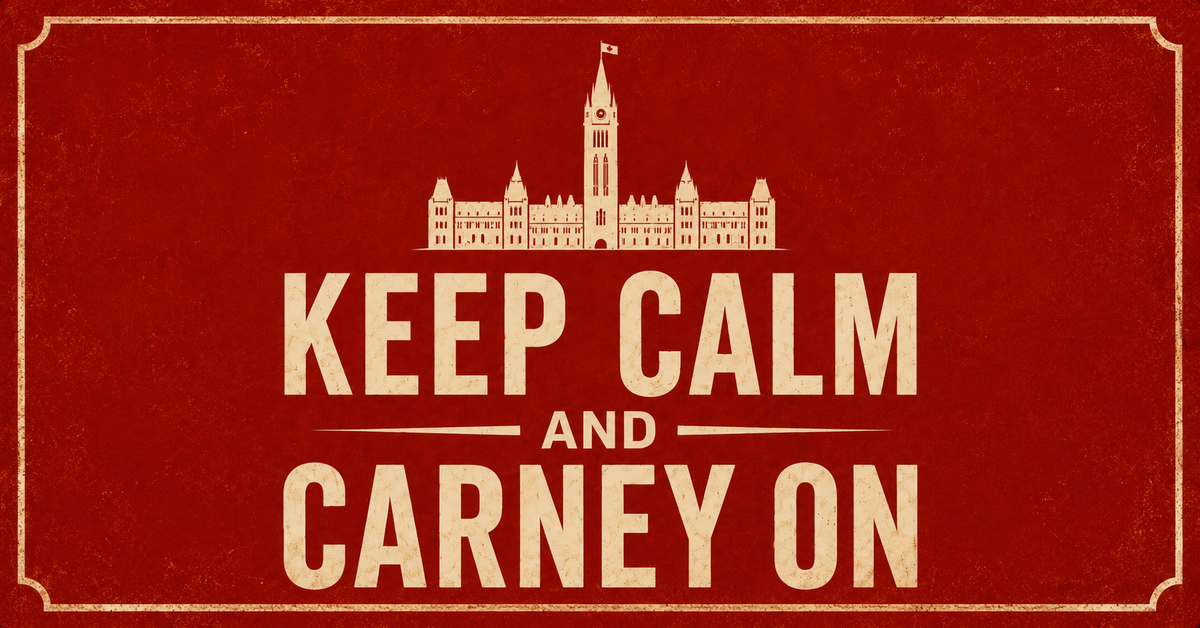
Which brings us to the poster:
Keep Calm and Carney On.
It's a joke, obviously. But there's a useful idea hiding inside it.
Calm doesn't mean passive, submissive or apologetic. It means keeping your head when the temperature rises and knowing the difference between firmness and theatre.
Carney has become noticeably sharper since the negotiations broke down. On Tuesday he told Washington it needed to “start being serious” before talks could resume and criticized the memes, insults and attempts to look tough that have increasingly surrounded the dispute. That's not exactly whispering into a diplomatic teacup. But neither is it the same thing as trying to conduct bilateral policy through personal taunts and social-media spectacle.
Canada needs negotiators who know the numbers, understand where we have leverage and where we don't, know when compromise serves us and know when saying no is the better option.
Carney's broader strategy has been to pair resistance to unacceptable U.S. terms with a push to strengthen the domestic economy and diversify Canada's international relationships. His government negotiated, walked away when it decided the terms no longer worked, consulted provinces and affected industries, announced support for sectors taking the hit, and accelerated a conversation Canada probably should have had years ago: how comfortable are we being this dependent on one enormous customer?
None of that means every decision is right. It means the approach should be judged by what it produces rather than how loudly it is announced.
The world is bigger than one border
Canada and the United States are neighbours, allies, friends and deeply integrated economic partners. Pretending otherwise would be ridiculous.
Our economies are woven together through energy, manufacturing, agriculture, services, investment and supply chains that often cross the border several times before a finished product reaches a customer. Canada should want a productive relationship with the United States.
But friendship and dependence are not the same thing.
In 2025, 71.7 per cent of Canada's merchandise exports went to the United States, down from 75.9 per cent in 2024. At the same time, Canadian merchandise exports to countries other than the United States increased 17.2 per cent. That's meaningful progress, but it also shows how concentrated Canada's trade remains.
The current dispute has made that old vulnerability much harder to ignore. When most of your economic eggs are in one very large basket, whoever controls that basket has considerable influence over you.
So Canada is looking elsewhere too. Good.
Sell Canadian products to Americans. Sell them to Europeans and Asians. Find customers anywhere Canadian companies can compete on reasonable terms. A healthy relationship with the United States doesn't require Canada to have nowhere else to go.
Diversification isn't anti-American. It's common sense.
Country before colour
Here's where things become uncomfortable for people who treat politics like professional sports.
If a Liberal government makes a good decision for Canada, Conservatives should be able to acknowledge it. If a Conservative government makes a good decision for Canada, Liberals should be capable of the same thing. And when either one screws up, Canadians should say that too.
Pierre Poilievre deserves some credit for how he responded when the latest U.S. tariffs landed. The Conservative leader called them unjustified, said Canada could not accept one-sided tariffs or a bad deal, urged Canadians to stand united behind Canadian workers and businesses, and offered to speak with the prime minister about the response. Then, in the same statement, he returned to criticizing Liberal economic policy and arguing for the Conservative alternative.
That's what an opposition is supposed to do.
National unity does not require political silence. Government and opposition should be able to argue hard about tactics without forgetting whose country they're arguing about.
The opposition is also right to demand transparency about what Canada rejected. Canadians should know as much as can responsibly be disclosed about the terms their government decided were unacceptable. Asking for that information is not disloyal. It's democratic oversight.
There are plenty of other legitimate questions. Are Canada's countermeasures well targeted? How long can affected industries absorb the damage? Will assistance reach workers and businesses that actually need it? Can Canada diversify trade quickly enough to matter? At what point could standing firm become economically self-defeating?
Those are exactly the questions Canadians should be asking.
This is not a blank cheque
The cheerleaders can leave the pom-poms in the closet.
Three by-election victories do not give Mark Carney unlimited permission to do whatever he wants. They don't erase domestic problems, make every Liberal policy brilliant or mean Canadians should stop scrutinizing the government because Donald Trump happens to make Canadian politics look unusually civilized by comparison.
And popular resolve does not make tariffs painless.
The Bank of Canada supplied a useful dose of cold water Wednesday. It held its policy rate at 2.25 per cent and said the new U.S. tariffs are unlikely to have a large direct effect on the economy as a whole because the targeted products represent about five per cent of Canadian exports to the United States. The Bank warned that affected sectors could still be hit hard, uncertainty could delay investment and hiring, and Canadian counter-tariffs could raise costs for businesses and feed into consumer prices over time.
In other words, standing firm does not make the bill disappear. It changes which bill Canada is willing to pay.
The same Angus Reid survey that found broad support for walking away also found significant anxiety about what the confrontation could mean for jobs. Canadians can believe the government made the right decision and still worry about the consequences. Those positions aren't contradictory. They're what happens when an important national decision comes with an actual price tag.
That's the bargain: stand up for Canada and Canadians may stand with you. Lose sight of Canadian interests and Canadians reserve the right to remind you who you work for.
Seems fair. We are Canadian, after all.
Maybe the by-elections are telling us something
Nobody should pretend three by-elections can tell us exactly what an entire country thinks. But Chicoutimi–Le Fjord is worth noticing.
The Conservatives had held the riding since 2018. On Monday, Liberal Daniel Gobeil won 51.3 per cent of the vote, the Bloc finished around 33 per cent and the Conservatives fell to 12.5 per cent. What had been expected to be a competitive race became a decisive Liberal pickup.
The riding is not economically detached from the dispute consuming Ottawa. Aluminum and dairy are important locally, and both are directly exposed to Canada–U.S. trade tensions.
Maybe it was the candidate. Maybe it was local politics. Maybe partisan preferences are shifting. Maybe the trade fight mattered. More than one of those things can be true at the same time.
Carney thinks the answer is clear. We should be more cautious.
What the result may suggest is that at least some Canadians are responding to something more elemental than party branding: represent us well, don't sell us short and don't confuse Canadian politeness with permission to push us around.
When you walk onto the world stage with a Canadian flag behind you, the country should matter more than the party.
That's a reasonable job description for a prime minister.
Any prime minister.
Canada doesn't need a strongman
There is another lesson hiding in all of this: strength doesn't have to look angry.
It doesn't need to shout, insult allies or threaten economic punishment every time somebody says no. Canada has its own political culture. It is imperfect, occasionally maddening and perfectly capable of generating nonsense without importing anybody else's.
But some Canadian instincts are worth preserving: fairness, pragmatism, professionalism, respect for allies, compromise when compromise makes sense, keeping your word and, when circumstances require it, being able to say no without throwing the furniture.
Those qualities are sometimes mistaken for softness. They're not.
Anybody can pound a table. Keeping your composure while defending your position is harder.
Keep calm
So yes, the Liberals had a very good Monday night. Congratulations. Enjoy the coffee.
But this isn't a Liberal victory lap, and Keep Calm and Carney On shouldn't become another personality slogan pasted onto a politician.
Canada doesn't need a cult of Carney. It needs competent leadership and an opposition willing to hold that leadership accountable. It needs Ottawa and the provinces capable of pulling in roughly the same direction when the national interest is genuinely threatened. And it needs citizens who can distinguish between supporting a politician and supporting the country that politician happens to represent.
Mark Carney should be judged by what he does next. If he protects Canadian sovereignty, represents the country professionally, opens new opportunities for Canadian businesses, helps workers and industries harmed by the trade dispute and remains willing to negotiate a fair agreement with our American neighbours, he deserves support. If he doesn't, we'll say that too.
No blank cheque. No requirement to change the colour of your political jersey.
Just Canada.
Keep calm. Stand up for Canada.
And as long as he keeps earning it—
Carney on.