Build Canada Strong? Then Finish the Water Job.
First Nations, with federal support, have lifted 156 long-term drinking-water advisories since 2015. Forty remain. Treat the rest as a national completion mission — and finish the job.
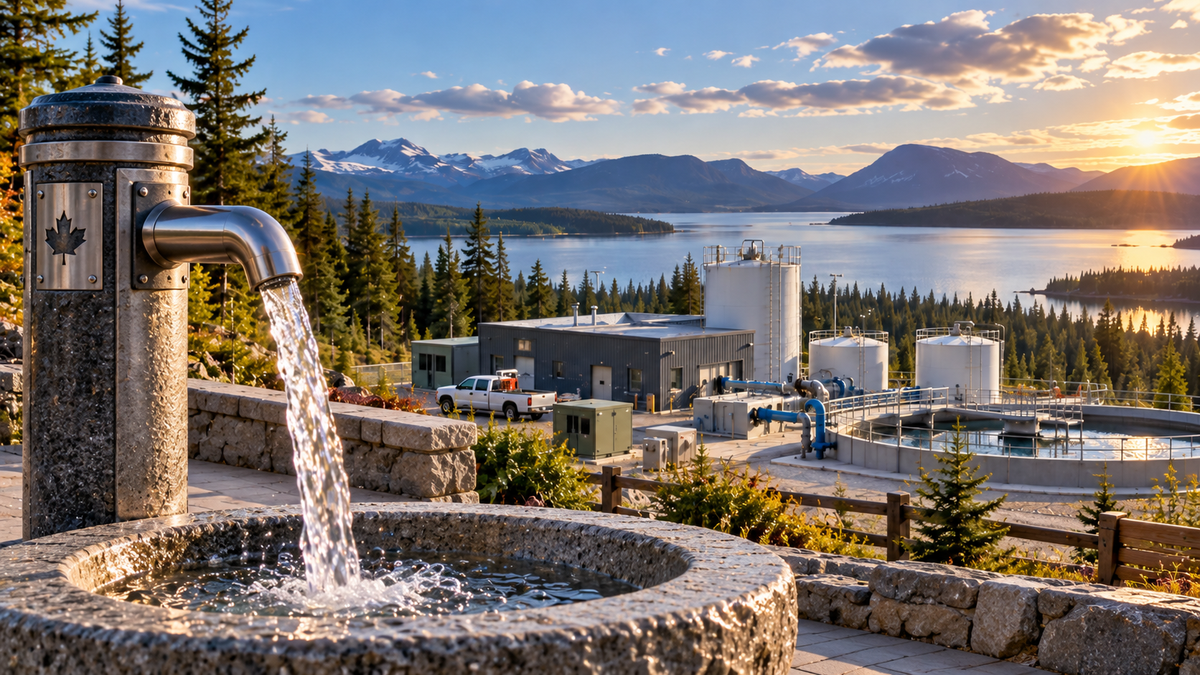
First Nations, with federal support, have lifted 156 long-term drinking-water advisories since 2015. That is real progress. Forty remain on public systems in 38 communities. Canada has shown it can move the number. Now finish the job — and make sure the water keeps flowing after the ribbon cutting.
Ottawa is in a building mood: ports, mines, power lines, trade corridors, housing and defence infrastructure. Governments are promising to move faster on projects that matter to Canada’s future.
Good. There is another nation-building project hiding in plain sight: a tap that works.
As of August 13, Indigenous Services Canada counted 40 active long-term drinking-water advisories on public systems on reserve in 38 First Nations communities, affecting roughly 5,780 homes and 344 community buildings. Since November 2015, First Nations working with federal support have lifted 156 long-term advisories, while Ottawa says more than $9.4 billion has been committed to improving access to clean water through projects benefiting hundreds of communities.
That progress deserves recognition. It also makes the remaining problem harder to excuse.
Give credit where it is due
Canada has not spent the past decade doing nothing.
Treatment plants have been built and repaired. Distribution systems have been upgraded. Operators have been trained. Communities have done the difficult work required to solve problems involving engineering, geography, staffing, procurement, power and long-term maintenance all at once.
Based on 2024–25 inspections, Indigenous Services Canada says 97 per cent of First Nations public drinking-water systems met the Guidelines for Canadian Drinking Water Quality. That is significant progress, and a Woodshed should not erase it simply because acknowledging success makes the argument less convenient.
The problem is that some of what remains has been around for an astonishingly long time. The federal tracker still lists a boil-water advisory at Neskantaga First Nation that dates to February 1995. The treatment-system upgrade and expansion are complete, but remaining deficiencies are still being addressed and the projected lift date remains “to be determined.” Sandy Lake has an advisory dating to 2002, Muskrat Dam to 2003 and Marten Falls to 2005.
Those are not missed quarterly targets. They are pieces of Canadian history nobody should be proud of preserving.
Progress is not the same as completion
This year provides a useful warning. So far in 2026, six long-term advisories have been lifted and seven have been added.
That does not erase the huge improvement since 2015. It shows why the next phase has to be different. Canada cannot finish the job simply by grinding down an old list while new problems age onto it.
The Auditor General reached much the same conclusion in its 2025 follow-up, finding that Indigenous Services Canada had not made satisfactory progress on any of the five recommendations from the 2021 drinking-water audit. Continuing concerns included recurring advisories, long-term solutions without implementation dates, operations-and-maintenance funding that did not adequately account for system condition, and the absence at that point of legally enforceable drinking-water protections comparable to those elsewhere in Canada.
There has been movement since then, as there should be. Audits are supposed to produce movement, not become recurring literature.
The last mile is not just concrete
One of the most revealing figures in the current federal tracker is 18: the number of affected systems that Indigenous Services Canada says already have infrastructure capable of producing clean drinking water. It also says 23 of the 40 need operational improvements before their advisories can be lifted, and the categories overlap.
That tells us the remaining job is more complicated than building 40 treatment plants and calling it a day.
Water systems need qualified operators, and those operators need training, competitive compensation and backup. Plants need maintenance, replacement parts, monitoring, reliable power, source-water protection and enough operating money to keep functioning long after the politicians have gone home from the announcement.
Indigenous Services Canada says it spent close to $380 million on operations and maintenance in 2024–25, while the federal government is also supporting operator training and other capacity initiatives. That work does not make for exciting ribbon-cutting photos, but it may matter more than the ribbon cutting itself.
Don’t count the ribbon cutting. Count the taps.
And keep counting them five years later.
Treat the remaining work like a completion mission
The federal government already understands reliable water infrastructure as nation-building when it talks about municipalities, housing growth and economic development. Its $51-billion Build Communities Strong Fund, for example, supports water and wastewater infrastructure alongside other community projects, with part of its direct-delivery funding reserved for Indigenous communities.
First Nations water projects do not need to be shuffled into that program. Indigenous Services Canada has its own responsibilities and relationships with First Nations. The larger point is simpler: if dependable water infrastructure is important enough to be part of Canada’s national building agenda elsewhere, the same urgency should apply on reserve.
Canada has also created a Major Projects Office because governments have finally admitted something fairly obvious: important projects can stall when money, engineering, procurement, approvals, jurisdictions and accountability are scattered across too many desks.
Nobody needs to designate every treatment-plant upgrade a megaproject. The remaining drinking-water problem could, however, use some megaproject discipline — without importing megaproject jurisdiction.
For each community, start with the solution developed with the First Nation. Identify the obstacle. Put the federal people capable of removing federal obstacles around the same table. Fund approved work, establish milestones, escalate delays and stop allowing solvable problems to wander between departments, contractors, programs and fiscal years.
That is not revolutionary management theory. It is finishing what you started.
Turn the tracker into a completion board
Ottawa already publishes a useful community-by-community drinking-water tracker. It should function more like a completion board and less like a historical ledger.
For each remaining long-term advisory, Canadians should be able to understand what the First Nation says the problem is, which solution is being pursued, what has been funded, what work remains, what is holding it up, what operator or maintenance requirements remain, the next meaningful milestone and the expected completion date. Where a responsible date genuinely cannot be given, explain why in plain English.
Much of that information already exists in pieces. The improvement would be to present every advisory as a project that is supposed to end, rather than another entry in a program expected to continue indefinitely.
The accountability should also continue after an advisory disappears from the federal website. A system that comes off an advisory, goes back on, comes off again and fails again is not a completed success story. It is a warning label with intermissions.
Use every tool Canada has — when communities want the help
Canada also has capabilities outside the normal infrastructure bureaucracy that should be available when communities request them.
Earlier this year, after a severe power emergency at Pimicikamak Cree Nation, Canadian Armed Forces engineers, logisticians and technical specialists worked with community leadership to assess critical infrastructure including water, wastewater and power systems. Canada has used similar emergency capabilities elsewhere, including water purification and distribution support.
That does not mean the military should run civilian First Nations water systems. Community leadership stays in charge, and permanent civilian infrastructure remains the objective.
But when a First Nation asks for assistance and specialized federal engineering, logistics, emergency-power or purification capability can help bridge a crisis or break a temporary bottleneck, departmental boundaries should not get in the way.
A reverse-osmosis unit in uniform is not a water policy. It can still be useful while the real solution gets finished.
Money and legislation matter. Results matter more.
Ottawa is also moving legislatively and financially. In June, the government introduced Bill C-37, the proposed First Nations Clean Water Act, alongside another $4.6 billion in targeted water and wastewater funding. The government says the bill would affirm First Nations jurisdiction over water on their lands, establish minimum protections and require work with First Nations on a long-term funding framework.
Those are serious commitments, but they are not a victory lap.
The Assembly of First Nations has raised significant concerns about the bill, including its reliance on “best efforts” language, the definition of First Nations lands, co-development provisions and how strongly the legislation commits Canada to the human right to water. The AFN estimates the broader First Nations water and wastewater infrastructure gap at roughly $44 billion.
Those disagreements have to be worked through with First Nations, not around them. Urgency does not require Ottawa to treat Indigenous jurisdiction as an inconvenience. Moving faster and working properly with First Nations are not contradictory goals; Canada should be capable of both.
Finish the job
Canada can legitimately be proud that 156 long-term drinking-water advisories have been lifted since 2015 while also being embarrassed that an advisory still on the federal list began in 1995.
The next phase should be more ambitious than another promise to “continue making progress.” Treat the remaining long-term advisories as a national completion mission, led with First Nations: remove the remaining advisories, stop temporary problems from becoming permanent ones, and make sure the systems remain reliable after the headlines disappear.
Build the ports, power lines, factories, trade corridors and houses. They matter.
But sometimes nation-building is considerably easier to explain.
Turn on the tap. And don’t stop until everybody can drink from it.