A Canadian Wind Tower Is Made of Steel. Why Is Washington Calling It a Security Threat?
Washington has declared imported wind equipment a security concern without imposing a new tariff. For Canadian manufacturers, the bigger question is how to protect industrial capability while building reliable, affordable power at home.
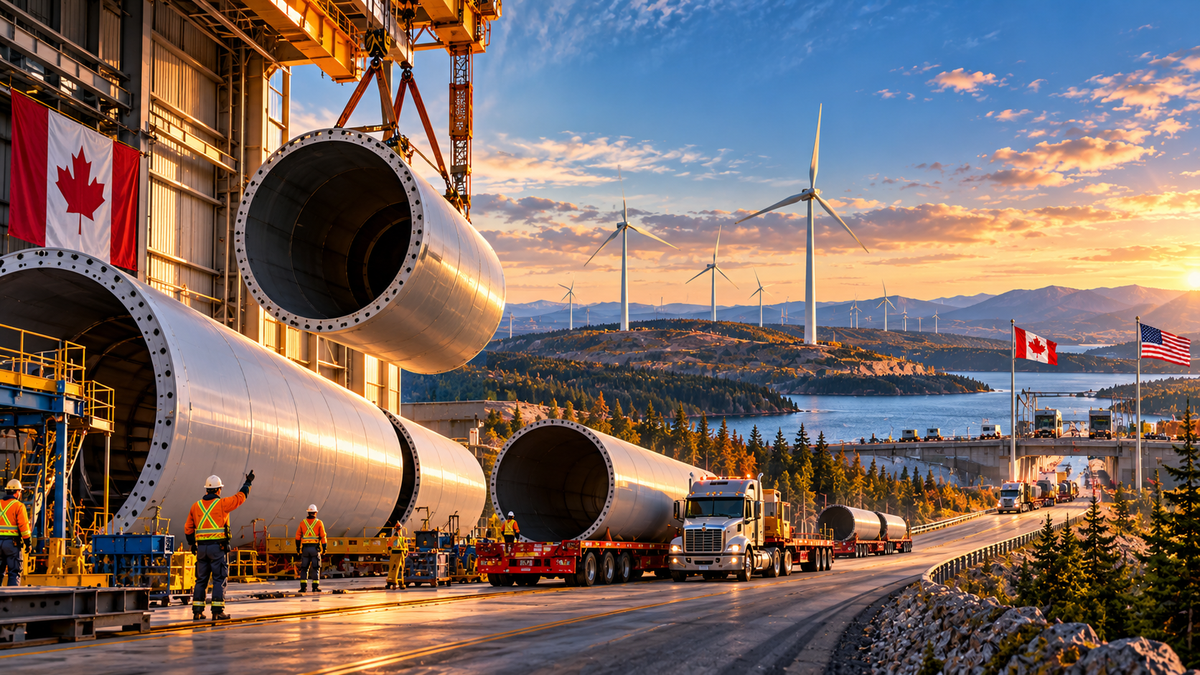
The steel sections of a wind tower and the computer systems inside a wind farm pose different risks. Washington's new import-security finding covers both. For Canada, that distinction matters at the border — and in deciding what we build here.
On October 22, the White House accepted a U.S. Commerce Department national-security finding covering imported wind turbines, their components and subcomponents. The proclamation cites cybersecurity, radar interference, dependence on foreign equipment and the challenges of integrating variable generation into an electricity grid.
It did not impose a new wind-specific tariff. U.S. commerce and trade officials were directed to negotiate with foreign partners and report progress within 180 days. Additional measures remain possible, while existing tariffs on certain steel, aluminum and copper products are unchanged. For Canadian suppliers, the immediate development is another layer of uncertainty about access to the American market — not a new customs charge that took effect yesterday.
A computer, a radar screen and a steel tower are not the same security problem
Wind farms are industrial networks, not just collections of spinning blades. Their software-connected controls and power electronics can introduce vulnerabilities. A U.S. Department of Energy account of Idaho National Laboratory research describes cyber incidents affecting wind-energy organizations and facilities in at least seven countries, along with risks involving remote monitoring, third-party access and interconnected equipment.
Radar interference is a different problem. Large towers and rotating blades can disrupt signals near sensitive aviation, weather and defence systems. The same U.S. department explains that careful siting and technical measures have allowed wind projects to coexist with radar operations in most cases. Neither problem is resolved simply by changing where a steel tower is manufactured.
The White House also criticizes wind generation for producing electricity when the wind is available, rather than on command. That is a genuine limitation, but it concerns the design of the power system. A Canadian-made tower does not become more or less intermittent when it passes through customs. Cybersecurity, radar performance and dependable electricity deserve serious answers; they do not all call for the same remedy.
Canada's wind-tower business already crosses the border
This is not the first American trade restriction confronting Canadian tower makers. In March, the U.S. International Trade Commission decided to retain existing antidumping and countervailing-duty orders covering utility-scale wind towers from Canada following a five-year review. The new national-security finding is separate from those trade-remedy cases, and some metal components may also face existing U.S. tariffs.
The commission's March 2026 report, table 1.7 and methodology note, estimates that imports from Canada in the relevant U.S. customs category fell from the equivalent of 374 towers in 2020 to two in 2024. These are not counts of individual towers unloaded at the border. Customs quantities were reported by weight and converted using an assumed 132,449 kilograms per tower, a conversion supplied by a domestic interested party. The category may also include products outside the review's scope.
The figures indicate a steep historical decline in that particular customs measure. They cannot establish current exports of all Canadian turbine components or quantify jobs threatened by the October proclamation.
Quebec-based Marmen manufactures wind towers in Trois-Rivières and Matane, and at a third plant in Brandon, South Dakota. It also performs related fabrication and assembly work. A company operating on both sides of the border complicates any neat division between American industry and foreign suppliers. Transport matters too: tower sections are enormous, and Marmen emphasizes its plants' proximity to highways, rail and ports.
There is a concrete Canadian customer for that expertise. In April, Vestas announced a 186-megawatt turbine order for Quebec's Forêt Domaniale project, naming Marmen as the tower supplier and saying the arrangement supports 150 direct jobs in Matane. That is the company's description of employment supported by the order — not confirmation that 150 entirely new positions have been created or that the project is already generating electricity.
The useful measure of industrial resilience is not simply whether a factory can export, but whether Canadian customers can sustain skilled fabrication, engineering, installation and maintenance when trade conditions change. It is equally important to ask which components are actually manufactured here. A locally welded tower does not make every blade, gearbox or control system Canadian.
Canada has reasons to build more wind power of its own
Hydro-Québec has set a target of adding 10,000 megawatts of wind capacity by 2035, with First Nations and municipalities participating in its development model. In British Columbia, four wind projects received electricity purchase agreements in May 2026, with First Nations partners and an expected combined 3,500 gigawatt-hours of annual production. Those are contracted projects and projected output, not electricity already flowing through the grid.
On the Atlantic coast, Canada and Nova Scotia announced a $100-million federally funded initiative in October to advance offshore wind development. The work includes floating wind-measurement buoys and modelling of transmission connections to markets beyond Nova Scotia. It is groundwork, not a funded fleet of operating offshore turbines. A strong wind resource becomes a commercial opportunity only when someone can finance, connect and buy its electricity.
More Canadian wind projects could support fabrication, ports, transport, electrical work, maintenance and specialized suppliers. Whether that happens depends on competitive bids, procurement terms, First Nations participation, permitting, transmission capacity and the ability of Canadian manufacturers to win contracts. A domestic project is not automatically a domestic supply chain.
A wind turbine has no fuel bill. Canadians still receive an electricity bill.
Wind farms need capital, roads, equipment, maintenance and grid connections, but they do not buy natural gas or oil to generate each additional unit of electricity. Trade disputes can still raise the up-front cost of steel and specialized components. The Canada Energy Regulator identifies the absence of fuel costs as an important difference in wind's operating economics.
That distinction can become valuable when events outside Canada send fuel prices higher. The Bank of Canada documented how Russia's 2022 invasion of Ukraine helped drive global energy and commodity prices upward, with consequences at Canadian gas pumps and grocery stores. Wind generation cannot shield households from those costs directly. But where it replaces some fuel-fired electricity at a competitive total cost, it can reduce one channel through which an international fuel-price shock reaches a provincial power system.
There is Canadian price evidence worth considering. In its 2024 clean-power procurement, BC Hydro's detailed regulatory filing, table 5, reports a weighted-average levelized bid price of $74 per megawatt-hour and an adjusted levelized cost to BC Hydro of $77 per megawatt-hour, both in 2024 dollars. The ten agreements covered nine wind projects and one solar project.
BC Hydro says the $74 measure was approximately 45% below its 2010 clean-power procurement after adjusting for inflation. That is evidence of competitive procurement, not proof that the new projects will reduce every household's electricity bill by 45%.
Consumers pay for an electricity system, not just generation at a wind farm. Transmission, distribution, balancing supply, storage, financing and utility rate-setting also affect the final bill. Hydro-rich provinces may have less direct exposure to natural-gas-fired electricity costs than other regions. The practical test is whether new wind provides dependable value within its particular grid, with full costs disclosed and fairly allocated.
Wind can offer some protection against volatile fuel prices. Buying that protection at any price would defeat the purpose.
Keep the lights on — and keep the benefits local
The electricity Canada needs for new industry, electric transport and AI data centres must be available when customers require it. Reservoir-backed hydro can provide flexibility; nuclear generation can contribute dependable output; and natural gas, storage, demand management and transmission can fill other roles, each with costs and environmental consequences. Federal reliability guidance recognizes that a more renewable grid must function as a complete system, not a collection of nameplate capacity figures.
That is particularly important for large electricity customers. Canada's Responsible Data Centre Development Principles say proponents should not shift project-driven electricity costs onto households and existing businesses. As Nasty Canuck has already examined, a proposed data centre needs an understandable agreement covering connection costs, dependable supply and the risks if expected demand does not materialize. Wind may contribute to that supply; it does not replace those agreements.
The benefits can be especially tangible in smaller systems. In Yukon, Kluane First Nation's 900-kilowatt Lhù'ààn Mân N'tsi project began operating in 2024 with a 500-kilowatt battery system alongside the existing diesel grid. The Nation says the equipment allows diesel generators to shut down when wind conditions permit, and forecasts replacing 310,000 litres of diesel annually. That saving is a projection, not a measured outcome. The turbine was manufactured in the Netherlands — a reminder that local energy control and Canadian-made equipment are related goals, not the same thing.
The Yukon example is not a template for every community. Wind resources, maintenance access, ownership, local priorities and the cost of dependable backup vary considerably. Its value lies in showing what a community-led combination of technologies can accomplish without pretending diesel generation simply disappears.
Wind development also carries environmental and community costs: land use, wildlife impacts, construction materials and new roads or transmission lines. Project approval and Indigenous rights are not details to rush past in pursuit of a capacity target. A strong Canadian industry should demonstrate useful energy, fair costs and local returns alongside lower operating emissions.
Build the capability, not the slogan
Washington has widened the range of wind equipment it considers a security concern while leaving further trade-policy decisions for later. Canada should take the stated cybersecurity and radar risks seriously without treating the steel tower, its digital controls and grid reliability as one undifferentiated problem.
At home, the durable answer is practical. Keep Canadian manufacturers competitive, give them a fair opportunity to supply projects, and build the transmission and backup that make variable power useful. Judge affordability by the complete electricity bill, not by a headline generation price. Done carefully, wind can complement hydro, nuclear and other sources while creating work in Canadian communities and reducing some exposure to fuel-price shocks beyond our control.
A wind tower is not a national energy strategy. But it can be a useful part of one.