Canada Can’t Build Air Power Alone. The Hard Part Is Choosing What It Must Control.
Canada cannot build every military capability itself. The harder question is which systems it must be able to operate and sustain, and where dependence on allies remains acceptable.
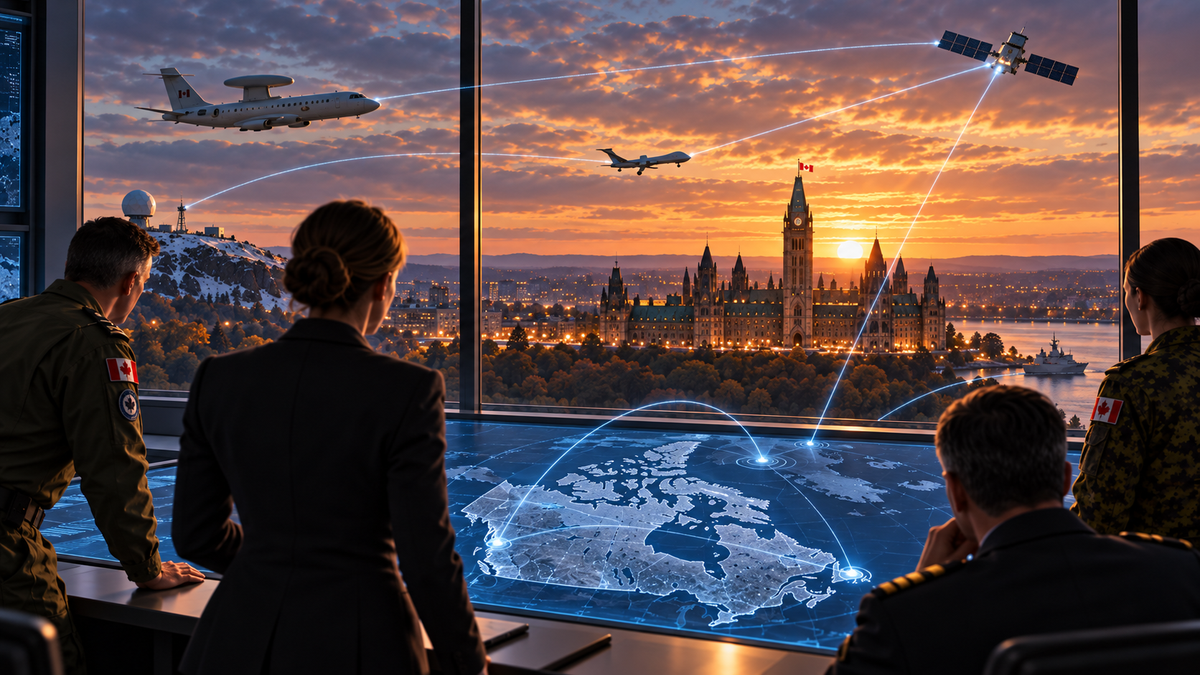
Canada’s new defence-industrial strategy draws a line between what should be built here, developed with allies and bought abroad. The harder test is whether Canada can still operate, repair and connect critical systems when a supplier, network or political relationship becomes difficult.
In the first article in this series, we looked at the system taking shape around Canada’s future fighters: sensors, surveillance, satellite communications, drones, support aircraft and the fighter fleet itself. The point was not that Ottawa had designed one seamless master plan. It was that all of those pieces eventually have to work together.
This follow-up starts with the less visible question underneath that system: what does Canada actually need to control?
Build–Partner–Buy puts control into the procurement test
Canada’s Defence Industrial Strategy gives Ottawa a framework for answering that question. Under Build–Partner–Buy, capabilities tied to Canadian industrial strengths or considered important to sovereignty are supposed to be built here where practical. Where Canada lacks the capability or gains an advantage from working jointly, the strategy calls for partnerships with trusted allies. Buying finished equipment abroad remains an option when neither route makes sense, but with conditions intended to preserve Canadian sovereign control over how the equipment is operated and sustained.
That is a more realistic starting point than trying to manufacture every military system domestically. Modern aircraft, sensors, weapons and communications systems are assembled from international supply chains, specialized software and technologies owned by companies and governments in several countries. Canada could spend enormous sums trying to duplicate all of that and still end up dependent on foreign inputs somewhere in the chain.
The strategy instead focuses attention on the parts of dependence that can become operational problems. It places particular weight on Canadian ownership, protection and access to intellectual property, domestic sustainment and secure supply chains. Those details determine what Canada can still do after the purchase ceremony is over.
The government is already using that framework in current air-power procurement. Ottawa describes its proposed GlobalEye airborne early-warning program as a PARTNER approach. The September 25 term sheet is still non-binding, and the Canadian configuration, industrial participation and program execution remain subjects for detailed negotiation.
Where something is built is only part of the answer
A Canadian assembly line does not automatically produce a sovereign capability. A platform built here can still depend on foreign software, encryption, specialized spare parts, export approvals or intellectual property that Canada does not control. The reverse can also be true: a foreign-designed system can provide substantial Canadian production, maintenance rights, technology access and operational freedom.
The distinction matters more as military equipment becomes software-heavy. Canada’s Defence Industrial Strategy explicitly warns that restrictions on access to intellectual property, schematics and software updates can affect the ability to operate and sustain advanced systems over time. The government says future procurement is supposed to give more weight to those rights rather than treating intellectual property as an afterthought.
For air power, that turns sovereignty into practical questions. Can Canadian personnel maintain and repair the system? Can Canada update critical software and operational data on a useful schedule? Are essential components and munitions available through more than one route? Can the platform still communicate with the rest of the force if a network is disrupted? How much outside approval is required to keep it functioning?
Different systems will produce different answers. Full Canadian control may be essential in one area and unnecessarily expensive in another. The important part is knowing where the line is before a disruption exposes it.
Communications make the dependency visible
Satellite communications are a useful example because the capability is easy to ignore until it disappears.
The first article noted Canada’s new military satellite communications program with Telesat and emerging space interoperability work with Norway. Those projects remain at different stages and do not amount to a finished alternative network. What they do show is that secure connectivity is being treated as a capability in its own right rather than invisible plumbing behind the aircraft and drones that attract the attention.
Recent operational experience shows why. Reuters reported that a global Starlink outage in 2025 interrupted U.S. Navy tests of unmanned surface vessels for almost an hour. Reuters separately reported that Starlink service was shut down over parts of Ukraine during a 2022 counteroffensive, disrupting communications and some drone operations.
Neither episode makes commercial satellite networks unsuitable for military use. Their speed, scale and coverage can be enormously valuable. The narrower lesson is that technical capability does not remove concentration risk. If a critical mission depends on one network, the consequences of an outage or access decision become larger.
For Canada, that makes redundancy a design question rather than a slogan. The objective is not to reproduce every communications service domestically. It is to identify the links that cannot safely become single points of failure — and to make sure another route exists when one disappears.
Diversification does not mean leaving the U.S. relationship
Canada’s effort to widen its defence partnerships is happening alongside, not instead of, its continental relationship with the United States. National Defence is investing $38.6 billion over 20 years in NORAD modernization, including surveillance, command-and-control, space-based systems, northern infrastructure and new weapons. The F-35 and other new Canadian capabilities will operate inside that broader North American framework.
The current trade dispute makes the dependency question less theoretical without turning it into a defence rupture. As the first article noted, the White House has directed officials to identify Canadian-origin items in the U.S. federal civilian procurement system that could, where lawful and warranted, be removed or made unavailable for purchase in response to Canada’s Buy Canadian policy. The memorandum does not change NORAD or the F-35 program, and it is not a blanket ban on Canadian companies.
It does demonstrate that integrated supply relationships sit inside political relationships. Canada’s European and Indo-Pacific partners have their own export rules, industrial priorities and future governments as well. Diversification can reduce dependence on one channel, but it cannot make politics disappear from defence procurement.
More partners can create more friction
Spreading risk has a price.
Every additional supplier can bring different maintenance requirements, security rules, software environments, training pipelines and contracts. Systems acquired from several countries still have to exchange data, share standards and fit into Canadian and allied command structures. A second route for critical parts or communications may improve resilience, but it may also require extra infrastructure, inventory and people.
That trade-off is easy to lose in discussions of sovereignty. A system built around one supplier may be cheaper and simpler to sustain until that supplier becomes unavailable. A more diversified system may be harder and more expensive to manage even if it offers more options during a disruption.
There is no universal answer because the cost of failure differs by capability. Losing access to an ordinary commercial component is not the same as losing a secure communications path, an encryption key, a weapons stockpile or the ability to update mission software.
The job is to identify where redundancy is worth buying before the failure occurs.
A practical sovereignty test
Before a defence purchase is described as strengthening Canadian sovereignty, a few questions are more useful than where the final assembly line sits.
Can Canada operate the capability without seeking case-by-case foreign approval? Can Canadian personnel sustain it during a supply interruption? Does Canada have the software, technical data and intellectual-property access needed to keep it current? Are critical spares, communications and munitions tied to a single external source? If one supplier or network becomes unavailable, is there a credible fallback?
Those questions do not require every answer to be “Canada does it alone.” They require the dependencies to be visible and deliberate.
That is where Build–Partner–Buy will eventually have to prove itself. The strategy can direct more work to Canadian firms, encourage technology sharing with allies and attach stronger conditions to foreign purchases. The individual contracts will determine whether those intentions survive contact with proprietary software, export controls, supply shortages, integration costs and the ordinary compromises of procurement.
Strategic autonomy is not measured by the number of maple leaves on a supplier list. It is measured by whether Canada can keep the system operating, adapting and connected when a dependency fails.
Build here where control matters. Partner where shared capability makes sense. Buy abroad where that is the better answer. But know, in advance, which dependencies Canada can live with — and which ones it cannot.
Editor’s note: This is the second article in Nasty Canuck’s Building Canadian Air Power series. Read the first article, “Canada’s First F-35 Is Flying. The Bigger Build Is Everything Around It.”