Canada Day Is Over. Bryan Adams’ “51st State” Still Has Something to Say.
Canada Day is over, but Bryan Adams’ “51st State” still offers a useful reminder: Canadian pride shouldn’t need an annual appointment.
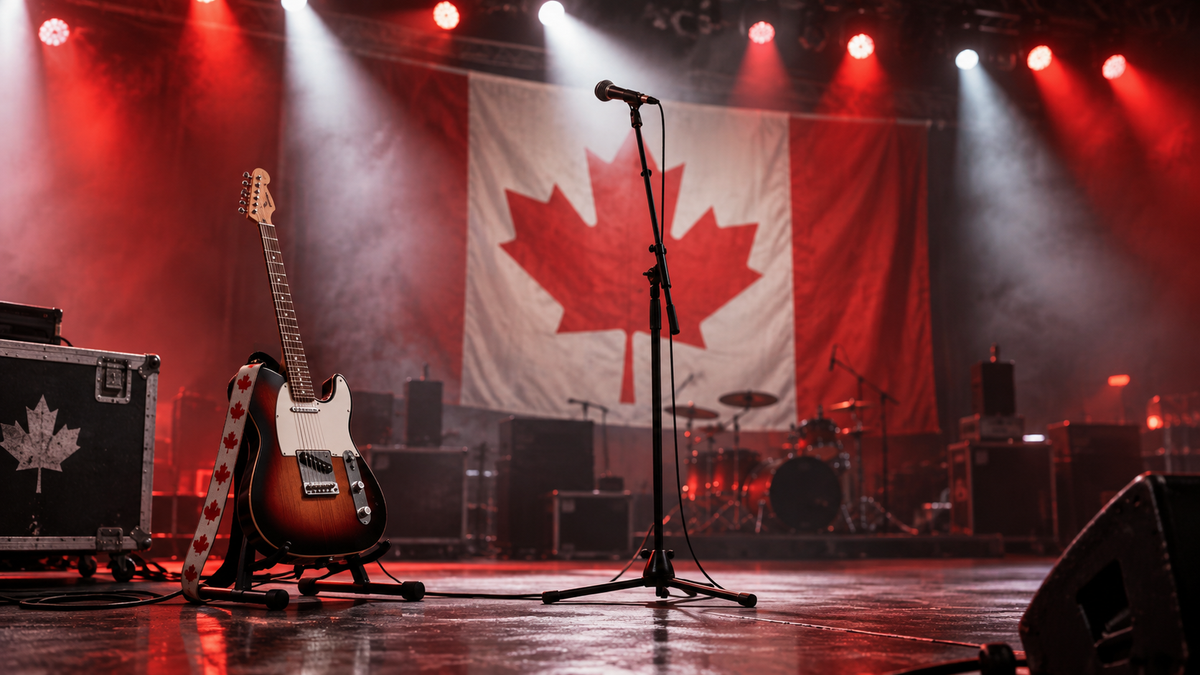
Fireworks last one night. Canadian confidence has to last all year. More than two months after Bryan Adams released “51st State,” its message may be more useful than it was on July 1.
Canada Day is the easy one. There are flags everywhere, communities hold ceremonies and concerts, somebody books the fireworks, and even people who spend much of the year complaining about the weather, the government or the price of groceries can usually find a few hours to remember that this is a pretty good country to call home.
Then the lawn chairs go back into the garage, the fireworks smoke clears, and Canada goes back to being something we live in rather than something we’re formally celebrating.
Which may be why Bryan Adams’ “51st State” is worth another listen now.
Adams released the song on Canada Day, with his official site describing it as a celebration of Canadian pride and identity. His explanation was wonderfully uncomplicated: “Canada is home.” He also said there is more binding Canadians together than dividing them, describing the song as a tribute to the country’s people, communities and spirit.
The initial coverage naturally attached the song to the political moment: one of Canada’s best-known musicians pushing back against Donald Trump’s repeated talk about Canada becoming an American state. More than two months later, the calendar has moved on. The issue hasn’t.
Over the Labour Day weekend, Trump posted another map showing the United States sprawling across North America and extending to Greenland and Iceland. On September 8, Canada’s new counter-tariffs took effect on $27.6 billion in U.S.-origin imports. Whatever anybody thought of the 51st-state rhetoric in July, it hasn’t exactly retired to Florida.
The larger question has stuck around with it: what kind of country does Canada want to be?
Adams’ answer still comes back to home.
Canada doesn’t need an enemy to know what it is
Adams has never needed to pretend Canadians and Americans are strangers. During a 2025 performance in Oklahoma, he told the crowd that Canadians loved their American neighbours even if that affection didn’t extend to wanting to become Americans. When Zoomer later asked him about the message behind “51st State”, he described the annexation idea simply as something Canadians don’t want to be part of.
Later in the same interview, Adams described himself as a citizen of the world, said he was proud to pull out his Canadian passport and added, “I’m not jingoistic though.” He also said America had been good to him and described Canadians and Americans as friends. That combination — proud of home without needing hostility toward the neighbour — may be the most useful part of the whole exercise.
Canada and the United States are neighbours, allies, trading partners, cultural cousins and, every so often, tremendous pains in each other’s arses. Millions of Canadians have American friends, relatives, colleagues and customers. Our economies are deeply connected. Musicians cross the border in both directions, families do the same, and businesses on either side depend on things made on the other.
The border matters, but not because it separates strangers. It marks the line between two sovereign countries with family, trade, culture, defence, tourism and friendship running across it every day.
The border can separate sovereignties without separating neighbours.
That relationship doesn’t become stronger by pretending the line no longer matters. In some ways it works precisely because there are two countries on either side, each free to make its own choices. Canadians don’t have to regard their country as an administrative inconvenience waiting for somebody to finish the merger paperwork in order to value everything we share with Americans.
“51st State” can reject annexation without rejecting America. Being pro-Canada is not the same thing as being anti-American, and a country comfortable with itself shouldn’t need an enemy to prove it deserves to remain itself.
July 1 can’t do all the work
Patriotism is easy when somebody schedules it for you. There is a date on the calendar, a flag in your hand and a fireworks show waiting after dark.
The harder version happens in September, February or on some ordinary Tuesday when nobody is singing the anthem and there isn’t a maple leaf painted on every storefront. That’s when Canadian confidence becomes less about ceremony and more about what we actually do: whether we build things here, support Canadian creators, learn our own history, understand the country beyond the part we happen to live in, improve our institutions instead of merely complaining about them, and defend Canadian interests without turning every disagreement into a permanent grievance.
Those things aren’t as photogenic as fireworks. They’re probably more important.
That’s why “51st State” has aged well. It doesn’t have to be an invitation for Canadians to stare south and stay angry. Its better use is as a reminder to pay attention to what is north of the border in the first place.
Canadian pride shouldn’t need an annual appointment.
He went looking for Canada instead
The song didn’t actually begin with the 51st-state talk.
Adams told Zoomer that the process started when he was asked to write for a German documentary about the Maritimes. He began researching Canada because he wanted to get the details right, then kept going into the country’s geography and history. One song became several, and he found himself wondering whether he should write an entire album about Canada. He told the magazine he hoped that Canada-themed album could be released in September or October.
That’s a better origin story than doom-scrolling American politics until a chorus appears.
The political moment supplied the spark for “51st State,” but curiosity about Canada supplied much of the fuel. Adams went looking at the country itself, which feels worth noting because Canadians consume an astonishing amount of American politics, American media and American arguments about America. We know their presidents, governors, Supreme Court fights, elections and culture wars in remarkable detail.
Sometimes we seem less curious about our own country.
A stronger Canadian identity probably won’t come from getting angrier every time somebody in Washington annoys us. Some of it may come simply from paying attention to Canada when nobody has provoked us into doing it — learning more about the North, the Prairies, Atlantic Canada, Quebec, Indigenous history, immigration, communities we rarely visit and industries we tend to notice only when something goes wrong.
Canada ought to be something we’re curious about, not merely something we defend when somebody else takes a shot at it.
Sovereignty has a cultural layer
Sovereignty usually gets discussed in fairly concrete terms. Factories matter. Energy matters. Food security matters. Technology, defence and infrastructure matter. Being able to build, repair, finance and operate important things inside your own country matters.
Culture belongs in that conversation too.
Not because musicians should be drafted into some government-approved national branding exercise. Nobody needs a Department of Catchy Choruses.
Countries are held together by more than borders and institutions. They accumulate songs, stories, jokes, arguments, memories and references that allow millions of people who have never met one another to recognize something familiar in the same place.
Canadian artists have been doing that for generations, usually without announcing that they’re engaged in nation building. Sometimes they write directly about Canada. Sometimes they don’t. A song doesn’t need a maple leaf in every verse to become part of how a country understands itself.
Adams is an especially good example because his career has never stopped at the border. His current tour schedule includes Canadian dates in September and U.S. dates later this fall.
You don’t have to retreat behind the border to value it.
Sovereignty doesn’t mean isolation. Canada can trade widely, welcome people and ideas from elsewhere, cooperate closely with allies and remain deeply connected to the United States without becoming less Canadian in the process.
The goal isn’t to build higher walls. It’s to know who you are when the door is open.
Maybe confidence sounds like this
There is a loud version of patriotism that needs flags everywhere, enemies nearby and constant reassurance that your country is the greatest civilization ever assembled. Canada has never been particularly convincing at that, which is probably for the best.
There is another version that suits us better: know what you have, admit what needs fixing, build the things that aren’t good enough yet, stand your ground when somebody pushes, work with your friends when you can and keep your sense of humour while you’re doing it.
Don’t mistake friendship for surrender. Don’t mistake hostility for strength either.
Bryan Adams didn’t write Canada’s foreign policy. He wrote a rock song, and more than two months after Canada Day that’s part of why it still works. We shouldn’t need July 1 to remind us that this place matters. Canadian pride has to survive the ordinary days when nobody is handing out little paper flags.
And if we occasionally need a reminder, fire up some Bryan Adams!