B.C. Changed Governments. Can Canada Keep Building?
B.C.'s incoming government inherits Ottawa's plans for energy, ports and power — and decisions on the Massey crossing and Indigenous rights.
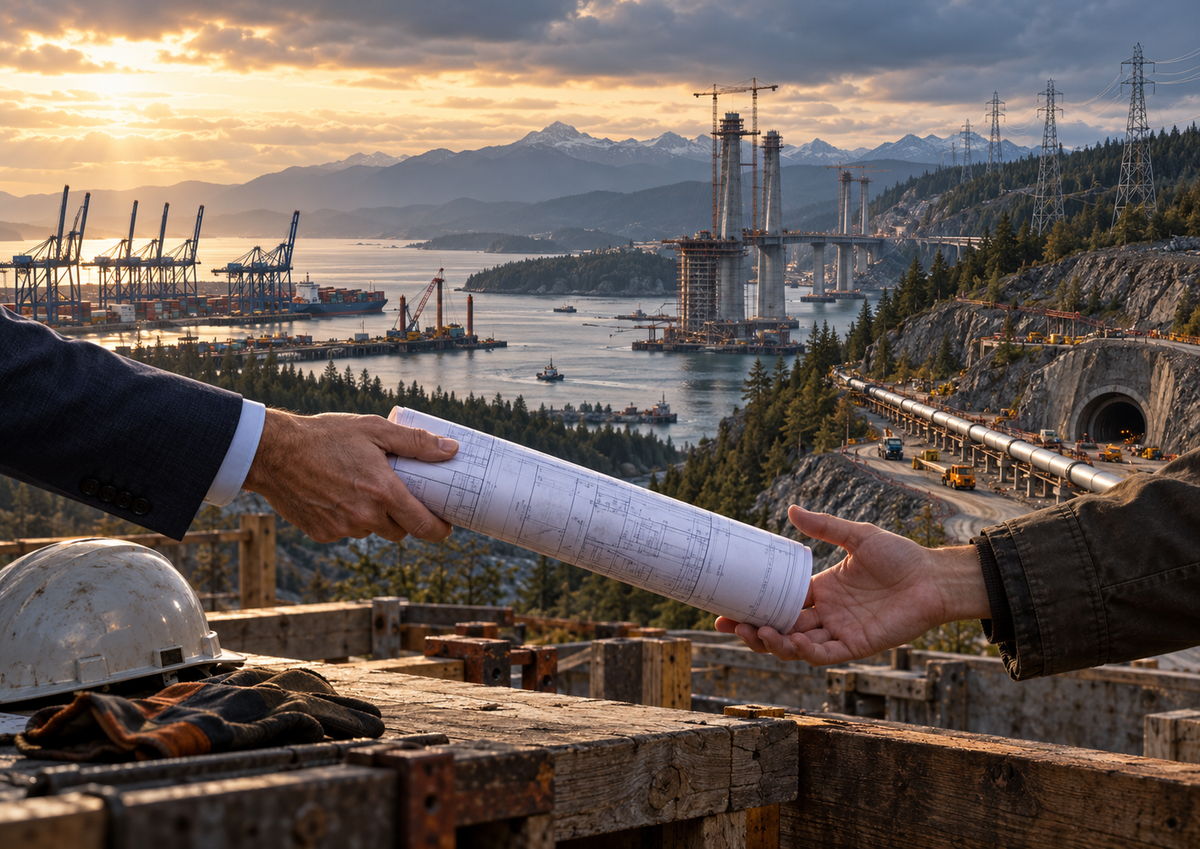
An early election has left British Columbia facing a Conservative majority on less than half the preliminary popular vote. Carney's plan to strengthen Canada's economy now has a different provincial partner — and some familiar projects to finish.
David Eby asked British Columbians to vote two years early, arguing that the American trade war had created an extraordinary moment. The voters have delivered an extraordinary answer of their own. The October 25 initial count from Elections BC shows Lorne Doerkson's Conservatives leading in 63 of the province's 93 ridings, compared with 28 for the NDP and two for the Greens.
The count is preliminary, with final counting scheduled for November 6–10. But the broader governing change is clear. It is also a test of something beyond provincial party fortunes: can Ottawa's Canada-strong economic agenda keep moving when the government at the country's Pacific gateway changes hands?
A big majority, with a smaller share of the vote
The Conservatives have 48.06 per cent of the preliminary popular vote but lead in 67.7 per cent of the seats. The NDP has 37.37 per cent and the Greens 10.97 per cent. Together, those latter two shares total 48.34 per cent, fractionally more than the Conservative share. Under first-past-the-post, however, seats go to whichever candidate finishes first in each riding, not to a province-wide combination of parties.
That arithmetic deserves attention, not a tidy theory that every Green vote otherwise belonged to the NDP. A combined NDP–Green total is not a coalition mandate, nor does it establish how their supporters would vote in a different contest. In Saanich South, for example, the preliminary riding count gives the Conservative candidate 10,549 votes, the NDP candidate 9,322 and the Green candidate 6,985. The three-way ballot produced a plurality winner; those numbers cannot tell us how people would have voted if a candidate were absent.
Turnout was lower, and the NDP lost votes. Compared with the certified 2024 vote totals, the Conservatives' preliminary 2026 tally is roughly 48,500 votes lower even as their seat count rises from 44 to 63. The NDP's tally is roughly 274,000 lower, and preliminary turnout is 48.14 per cent, against 58.45 per cent in 2024. The final count may adjust those numbers, but vote-splitting alone cannot explain the scale of the shift.
Eby framed his September 22 election call as a chance for British Columbians to choose a response to Washington's economic pressure. The campaign also began amid turmoil in the Conservative caucus. In a September 22–24 Angus Reid Institute online survey of 801 B.C. adults, 62 per cent said it was too soon for an election, compared with 21 per cent who considered the timing right. Another 65 per cent said they believed Eby was placing his interest in remaining in office above the province’s. Those are reported perceptions, not proof of motive, but they document unhappiness with the call before election day; they do not prove that the early date determined how individual voters cast their ballots.
The party map was shifting before anyone voted. As The Canadian Press reported when the election was called, Conservative MLAs who had left or been expelled were returning to a caucus under new interim leader Doerkson. The right entered the campaign less fragmented, while the NDP and Greens remained separate choices. The NDP entered that campaign with a legislative majority and is now headed into opposition, while Eby has announced his departure as party leader. Holding an election early was a political choice; the public is entitled to scrutinize both its justification and its result.
Ottawa already had a B.C. agreement
There is a detail missing from the idea that the departing NDP government simply spent its time obstructing Canada's economic renewal. On July 2, Eby and Prime Minister Mark Carney announced a Canada–British Columbia Cooperative Prosperity Agreement. It encompassed LNG projects, the North Coast Transmission Line, ports, critical minerals, training, environmental measures and Indigenous partnerships.
The July 2 federal announcement included $3.9 billion, through various financial tools, toward the first two phases of the North Coast Transmission Line and support of up to one-third of capital costs, capped at $3 billion, for the George Massey tunnel replacement. Ottawa also outlined support for major Roberts Bank terminal improvements. These are commitments and project plans, not a ledger of completed infrastructure or realized economic gains. Phase 1 of the transmission line broke ground on September 3; other financing and delivery obligations remain to be worked out.
The July agreement also calls for an implementation committee to coordinate and monitor measurable progress; it does not establish that the committee is already operating. Its Annex A timetable sets a December 1, 2026 milestone for detailed financial arrangements on the Massey crossing and North Coast Transmission Line, support for LNG exports, and financial commitments related to a possible pipeline to Asian markets. Those are milestones for agreements and arrangements, not deadlines for completed construction.
That gives Ottawa and the incoming provincial government a documented mechanism and a calendar to work from instead of pretending everything begins with a new handshake. Some work is already underway, other commitments may be renegotiated, and financing, permitting and ownership questions will still need answers. Canada cannot diversify its trade simply by changing the party colours on a provincial map.
An energy partnership is possible. Delivery is another question.
Doerkson's party has pledged to double B.C.'s natural-gas production by 2032 and triple it by 2035, while accelerating approvals and encouraging investment. That establishes an area of policy overlap with Carney's push to export more Canadian energy to markets beyond the United States. Yet a target is not a producing terminal, an electricity connection or a signed purchase contract.
The alignment is unusually explicit on oil. When Carney listed the proposed Pacific Link pipeline as a project of national interest on October 1, Doerkson welcomed the decision and proposed a working group with Ottawa and Alberta. The federal designation enables an accelerated review process; it does not establish a finished route, a construction permit or a commercially operating pipeline.
The July agreement had taken a more guarded provincial position: B.C. said it did not seek the oil pipeline but would engage in routing and permitting discussions in good faith, conditional on Canada maintaining the federal North Coast tanker ban, consulting First Nations, and negotiating provincial revenue-sharing and environmental-liability arrangements. Doerkson’s welcome signals a different provincial approach; it does not, by itself, settle those existing commitments or the route.
For Ottawa, the proposed line is part of a strategy to reduce reliance on the U.S. market. For the incoming B.C. government, the questions will include which communities participate, how environmental and regulatory conditions are set, who carries the financial risk and what benefits remain in the province. Agreement on the destination is not agreement on every road leading there.
The bridge, the tunnel and the rights that remain
There is already one practical collision. Carney's July agreement offered up to $3 billion toward an eight-lane George Massey replacement tunnel. Doerkson's Conservatives campaigned instead on a 10-lane bridge. The congestion problem is the same; the proposed engineering solution is different. Whether federal money, previous design work and approvals can be carried across to a bridge requires a negotiation, not a press release.
The larger and more sensitive test concerns First Nations. The Conservatives say they intend to repeal B.C.'s Declaration on the Rights of Indigenous Peoples Act while pursuing economic partnerships. In its October 25 response, the First Nations Leadership Council said it is ready to work with the next government but called for the law to remain. It also criticized the Eby government for failing to explain and implement that framework clearly enough.
Those positions should not be flattened into a choice between building projects and respecting rights. Constitutional Aboriginal and treaty rights do not disappear if a provincial statute is repealed. Serious project certainty will depend on consultation, lawful decisions and arrangements that communities can examine and accept or contest. Speed without durable consent and legal clarity can become delay under another name.
A stronger Canada has to survive an election
Carney has publicly congratulated Doerkson and indicated he wants to work together on housing, energy and Canada's economic strength. The next meaningful evidence will come from specific decisions: the status of the July agreement, the Massey funding arrangement, Pacific Link's consultation and review, transmission-line delivery, and the incoming government's first decisions on Indigenous-rights legislation.
British Columbia's voters have changed the provincial government. They have not changed the geography of Canada's Pacific ports, the need for trade routes beyond the United States, or the fact that major infrastructure crosses political and jurisdictional boundaries.
A national economic plan should be able to withstand a provincial election. Whether this one can will be measured less by the promises made in Ottawa or Victoria than by the projects that move, the obligations that are honoured and the results Canadians can actually see.